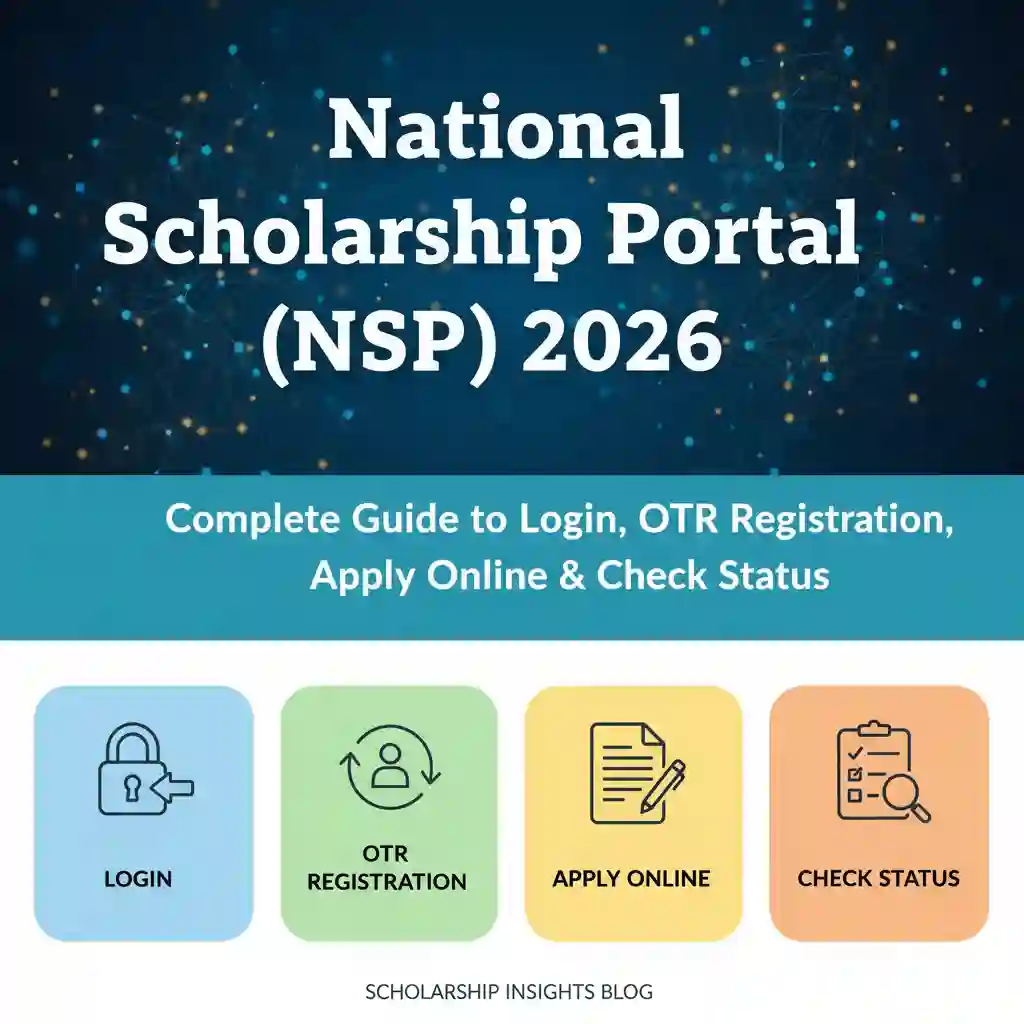
National Scholarship Portal (NSP) 2026: Complete Guide to Login, OTR Registration, Apply Online & Check Status
Let’s be honest. The Indian education system has no shortage of scholarship schemes. What it has traditionally lacked is a single, reliable place where a student can find them all, apply without confusion, and actually receive the money in their bank account.
That’s exactly what the nsp scholarship portal — NSP — was built to fix.
Whether you’re a Class 9 student from a small town in Bihar, a first-year engineering student in Tamil Nadu, or a PhD scholar in Delhi — the NSP portal at scholarships.gov.in is your gateway to government-funded financial support for your education. Over 140 scholarship schemes. One platform. Zero middlemen.
In this guide, National Scholarship Portal we’ll walk you through everything you need to know about NSP 2026: what it is, how to register with OTR, how to log in, how to apply for the right scheme, how to check your application status, and what to do if your payment hasn’t arrived. Clear steps. No confusion.
📌 Quick Facts: Official website: scholarships.gov.in | Ministry of Statistics scholarship deadline: April 8, 2026 | DARE scholarship deadline: April 22, 2026 | Application for AY 2024-25 is currently open.
What Is the National Scholarship Portal (NSP)?
The National Scholarship Portal, commonly called NSP, is a digital platform launched by the Government of India under the Ministry of Electronics and Information Technology (MeitY) as part of the Digital India initiative. It operates under the National e-Governance Plan (NeGP) and follows the SMART principle — Simplified, Mission-oriented, Accountable, Responsive, and Transparent.
Before NSP existed, a student who wanted to apply for a minority scholarship had to go to one website, while a student looking for a pre-matric SC scholarship had to go to another. State-level scholarships were on yet another portal. Documents were submitted in triplicate. Verification took months. Money sometimes never came.
NSP changed all of that. Today, the portal hosts more than 140 scholarship schemes offered by central government ministries, state governments, and educational bodies like AICTE and UGC. Everything — registration, application, document upload, institute verification, department approval, and payment — happens on one platform, with funds transferred directly via Direct Benefit Transfer (DBT) into the student’s Aadhaar-linked bank account.
💡 Scale: National Scholarship Portal NSP has disbursed scholarships to millions of students across India since its launch. It covers everything from Class 1 to PhD level — making it one of the most comprehensive student support platforms in the world.
Major Scholarship Schemes Available on NSP 2026
Here’s an overview of the key scholarship categories hosted on the National Scholarship Portal:
| Scholarship Scheme | Who It’s For | Amount (Annual) |
| Pre-Matric Scholarship (SC/ST/OBC/Minority) | Class 1 to 10 students | Varies by scheme |
| Post-Matric Scholarship (SC/ST/OBC/Minority) | Class 11 to PhD | Up to ₹1.23 lakh |
| National Means-cum-Merit Scholarship (NMMS) | Class 9 to 12 (merit + income) | ₹12,000/year |
| AICTE Pragati Scholarship (Girls) | Girl students in AICTE colleges | ₹50,000/year |
| AICTE Saksham Scholarship (Divyang) | Students with disabilities | ₹50,000/year |
| PM Scholarship Scheme (PMSS) | Wards of Ex-Servicemen/CAPF | ₹36,000/year (girls) |
| Top Class Education (SC Students) | SC students in top institutions | Full tuition + fees |
| INSPIRE Scholarship (DST) | Science students, Class 11–PhD | ₹80,000/year |
This is not an exhaustive list — NSP hosts dozens more. Always log in to the portal and use the ‘Search for Scholarship’ feature to find schemes specific to your state, category, and course.
NSP OTR Registration 2026 — Your First and Most Important Step
Before you can apply for any scholarship on National Scholarship Portal NSP, you need to complete One Time Registration (OTR). This is a one-time process — you won’t need to register again in future academic years. OTR generates a unique 14-digit number linked to your Aadhaar that serves as your permanent identity on the portal throughout your academic life.
How to Complete NSP OTR Registration
- Go to scholarships.gov.in — the official NSP website
- Click on ‘New Registration’ or ‘OTR Registration’ on the homepage
- Select your applicant type: Student (most users) or Institution
- Enter your Aadhaar number (or Aadhaar Enrolment ID if card not yet issued)
- Complete e-KYC via OTP sent to your Aadhaar-linked mobile number
- If OTP fails — your mobile may not be seeded with Aadhaar. Use the NSP OTR App for face authentication instead
- After successful e-KYC, your 14-digit OTR number is generated and sent to your registered mobile
- Set a password — this OTR number + password is your NSP login credential going forward
Important: If your Aadhaar biometric is locked, face authentication during OTR will fail. Unlock it first using the mAadhaar app or at myAadhaar.uidai.gov.in before attempting OTR registration.
📱 NSP OTR App: Download the NSP OTR app from Google Play Store for face-authentication-based registration — ideal if your Aadhaar mobile number is inactive or changed.
How to Login to NSP Portal — Fresh & Renewal Students
Once you have your OTR number, logging in is straightforward. But many students get confused between the fresh application login and renewal login. Here’s the difference:
Fresh Application Login (New Students)
If this is your first year applying for a scholarship on NSP, you are a ‘fresh applicant’. After generating your OTR, go to scholarships.gov.in → Login → enter your OTR number and password → select ‘Fresh Application’ from your dashboard.
Renewal Application Login (Returning Students)
If you received a scholarship last year and want to continue receiving it, you need to apply for renewal. You don’t create a new OTR — log in with your existing OTR number. Renewal applications have their own separate window and deadline, which often opens a few weeks after fresh applications close.
Note: All Renewal students who have received a Reference Number on their registered mobile should generate OTR using only that reference number. Do not register as a new student — doing so creates a duplicate and delays your payment.
How to Apply for Scholarship on NSP — Step by Step
Once logged in with your OTR number, here’s how to submit your scholarship application: National Scholarship Portal
- Log in to scholarships.gov.in with your OTR number and password
- Go to ‘Application Form’ section on your dashboard
- Select the correct scholarship scheme — this is critical (see section below on choosing the right scheme)
- Fill in your personal details: name, date of birth, gender, category, Aadhaar number
- Fill in academic details: institution name, course, year of study, previous year marks
- Fill in bank details: account number, IFSC code — must be Aadhaar-linked for DBT
- Upload required documents (see documents section below)
- Review every field carefully — mistakes here cause rejection
- Submit the application — you will receive an application reference number via SMS
- Your application now goes to your Institution for verification — track this on your dashboard
⚠️ Critical Rule: You can apply for only ONE scholarship scheme on NSP. Applying to multiple schemes will result in rejection of all applications. Choose carefully before submitting.
How to Choose the Right Scholarship Scheme on NSP
This is where most students go wrong — and it results in immediate rejection. Here’s a simple framework to find your correct scheme:
- Are you from SC/ST/OBC/Minority community? → Look under Ministry of Social Justice, Tribal Affairs, or Minority Affairs
- Are you a girl student in an AICTE-approved engineering/pharmacy college? → AICTE Pragati Scholarship
- Are you a student with a disability? → AICTE Saksham Scholarship
- Are you from a defence family? → PM Scholarship Scheme (PMSS) — apply via KSB portal or NSP under Ministry of Home Affairs
- Are you a science student (Class 11 onwards) pursuing pure sciences? → INSPIRE Scholarship by DST
- Are you a meritorious student from a low-income family in Class 9-12? → National Means-cum-Merit Scholarship (NMMS)
- Are you from the railway/RPF family? → Apply under Ministry of Railways section
When in doubt, use the ‘Search Scholarship’ feature on the NSP homepage. Enter your state, category, and education level — it will show you all eligible schemes automatically.
Documents Required for NSP Scholarship Application
Keep scanned copies of these documents ready before you start filling the form. Poor quality scans are one of the top reasons for verification rejection at the institution level.
- Aadhaar card (mandatory — used for identity verification and DBT payment)
- Bank account passbook (account must be in the student’s name and Aadhaar-linked)
- Previous year’s mark sheet or Class 10/12 certificate (minimum marks as per scheme)
- Income certificate of parent/guardian (issued by competent authority — tehsildar/SDM)
- Caste/community certificate (for SC/ST/OBC/Minority schemes)
- Bonafide/enrollment certificate from current institution
- Disability certificate (for Saksham scholarship — issued by government hospital)
- Passport-size photograph (recent, white background)
- Domicile certificate (required by some state-level schemes)
Scanning tip: All documents should be scanned in PDF or JPEG format, minimum 100 DPI, maximum file size as specified on the portal (usually 200KB–500KB per file). Use a mobile scanner app if you don’t have a physical scanner.
How to Check NSP Application Status Online
After submitting your application, it passes through multiple verification stages before payment is released. Here’s how to track it:
Step-by-Step Status Check
- Go to scholarships.gov.in
- Log in with your OTR number and password
- Click on ‘My Application’ from the dashboard
- Click ‘Status’ — you will see the current stage of your application
Understanding the Status Stages
| Status | What It Means | Action Needed |
| Submitted | Application submitted, awaiting institute review | None — wait for institute verification |
| Institute Verified | College/school approved your application | None — moves to L2 verification |
| L2 Verified | State/district nodal officer approved | None — moves to sanction |
| Sanctioned | Scholarship approved — payment processing | Check bank account in 7–15 days |
| Payment Transferred | Amount sent to your bank via DBT | Verify receipt in bank account |
| Rejected | Application rejected — reason shown | Fix the issue and re-apply in next cycle |
If your application is stuck at ‘Institute Verified’ for more than 3-4 weeks, your State Nodal Officer may not have reviewed it. Go to the NSP portal → Nodal Officer (Scheme-wise) under Public → find your district/state nodal officer’s contact → send a polite email with your application reference number requesting review.
How to Track NSP Scholarship Payment via PFMS
Once sanctioned, scholarship payments are processed through PFMS — Public Financial Management System. You can track the exact payment status here:
- Visit pfms.nic.in (Public Financial Management System portal)
- Click ‘Know Your Payment’ or ‘Track NSP Payment’
- Enter your bank account number and bank name
- The portal shows whether payment has been sent, processed, or returned
If PFMS shows ‘Payment Transferred’ but you haven’t received it in your account, the most common causes are: Aadhaar not seeded with your bank account, incorrect IFSC code in your NSP application, or your account being dormant. Visit your bank immediately with your Aadhaar card to resolve.
📞 NSP Helpdesk: Call: 0120-6619540 | Email: helpdesk@nsp.gov.in | Available Monday to Saturday, 10 AM to 6 PM. Keep your OTR number and application reference number ready before calling.
Common Mistakes Students Make on NSP — And How to Avoid Them
Every cycle, thousands of eligible students lose their scholarship because of avoidable errors. Here are the ones that show up most often:
Mistake 1: Applying for the Wrong Scheme
Fix: Use the ‘Search Scholarship’ feature on the homepage. Read the eligibility criteria fully before selecting any scheme.
Mistake 2: Bank Account Not in Student’s Name
Fix: The bank account on NSP must belong to the student — not a parent or sibling. If you don’t have your own account, open one before applying. It must also be Aadhaar-linked for DBT to work.
Mistake 3: Uploading Blurry or Wrong Documents
Fix: Scan at 200 DPI minimum. Rename files clearly. Do not upload a photo of your caste certificate when asked for income certificate — it sounds obvious but happens frequently.
Mistake 4: Using UC Browser or Old Browser Versions
Fix: Use Google Chrome (updated) on desktop or mobile. The NSP portal’s captcha, OTP submission, and document upload don’t work reliably on older or alternative browsers.
Mistake 5: Missing the Institute Verification Deadline
Fix: After you submit your application, it goes to your institution for verification. Follow up with your college/school admin within 3–5 days of submission. If they miss the verification window, your entire application lapses for that cycle.
Mistake 6: Applying as a Fresh Student When You’re a Renewal Student
Fix: If you received an NSP scholarship last year, log in with your existing OTR. Do not create a new registration — it will create a duplicate entry and flag your account for review.
NSP 2026 Important Dates to Remember
Scholarship deadlines on NSP National Scholarship Portal vary by scheme. As of April 2026, here are the active deadlines:
- Ministry of Statistics & Programme Implementation scholarship: April 8, 2026
- Department of Agriculture Research and Education (DARE) scholarship: April 22, 2026
- Fresh applications for most central schemes: Typically opens June–August every year
- Renewal applications: Usually opens 4–6 weeks after fresh applications
- Institute verification window: Closes approximately 15 days after student submission deadline
- L2 (State/District) verification: Typically closes 30 days after institute deadline
These dates change every academic cycle. Always verify the exact deadline on scholarships.gov.in before assuming. Missing a deadline by even one day means waiting an entire year for the next cycle.
Frequently Asked Questions About NSP 2026
Can I apply for more than one scholarship on NSP?
No. NSP National Scholarship Portal strictly allows only one active scholarship application per student. If you apply to multiple schemes, all may get rejected. Identify the most relevant scheme and apply for that one only.
What if I don’t have an Aadhaar card?
Aadhaar is mandatory for NSP National Scholarship Portal OTR registration. If you don’t have an Aadhaar card, apply for one at your nearest Aadhaar Seva Kendra immediately — the NSP portal even has a link to find the nearest centre. Without Aadhaar, you cannot complete OTR or receive payment via DBT.
My application was rejected. Can I re-apply?
Yes, but typically only in the next academic cycle. Check the rejection reason on your dashboard (it’s usually displayed next to the status). Fix the issue — wrong document, income certificate expired, bank account mismatch — and apply fresh in the next window.
How long does it take to receive the scholarship money?
From the date of sanction, payment typically reaches your bank account within 15–30 working days via PFMS/DBT. Some schemes disburse annually, others semester-wise. Check your specific scheme’s payment schedule on the NSP portal.
I submitted my application but my college hasn’t verified it. What should I do?
Contact your college scholarship coordinator or admission office immediately. Provide them your NSP National Scholarship Portal application reference number and request verification. If they’re unresponsive, escalate to your institution’s principal. Missing the institute verification window is not something NSP can fix retroactively.
Final Thoughts — Your Education Deserves This Support
The National Scholarship Portal is one of the most powerful tools the Government of India has created to keep deserving students in school and college. It’s transparent, digital, direct, and real. More than 140 schemes. One login. Money straight to your bank account.
But like every government system, it rewards the students who prepare, read the guidelines, submit before the deadline, and follow up with their institutions. It’s not complicated — it just requires attention.
If you’re eligible for any scholarship listed on NSP 2026 — and chances are you are — the biggest mistake you can make is waiting. Scholarship windows close. Deadlines don’t extend. A few hours of effort today could mean thousands of rupees every year supporting your education.
Go to scholarships.gov.in. Complete your OTR. Find your scheme. Apply. And if this guide helped you, share it with a classmate, a sibling, or anyone who’s studying and struggling with fees. One forwarded link could change someone’s academic year.
🔗 Official Links: Apply: scholarships.gov.in | OTR App: Play Store (NSP OTR) | PFMS Payment Tracking: pfms.nic.in | Helpdesk: 0120-6619540