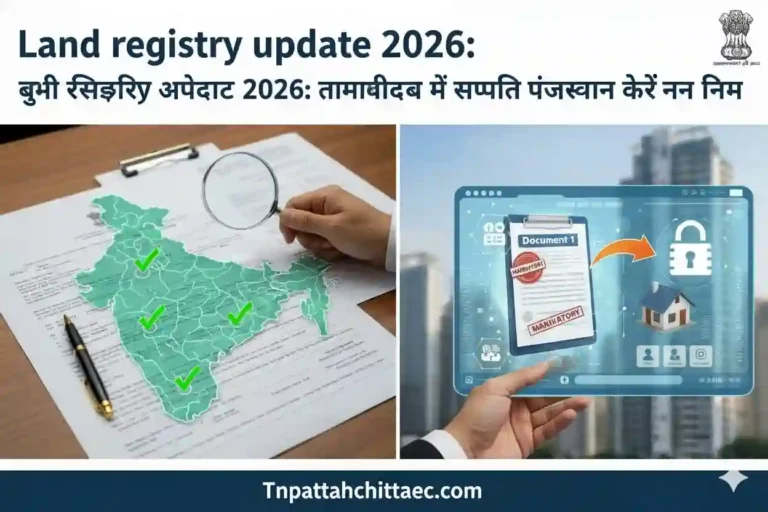
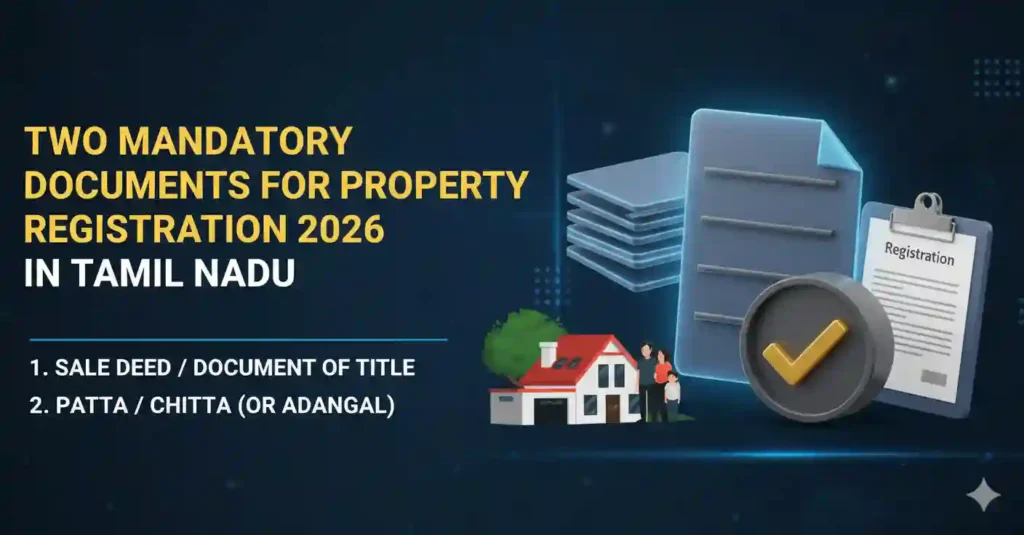
Two Mandatory Documents for Property Registration 2026 in Tamil Nadu
Are you planning to buy or sell property in Tamil Nadu in 2026? If yes, there is one critical update you need to know before you step into any Sub-Registrar Office (SRO) or log in to the TNREGINET portal, Two Mandatory Documents for Property Registration.
The Indian government — along with state registration departments across the country — has made two specific documents absolutely mandatory for all property registrations in 2026. Missing even one of these documents can halt your entire registration process, delay your property transaction, and in some cases even invalidate it legally.
In this complete guide, we break down exactly which two mandatory documents are required for property registration in Tamil Nadu 2026, why they matter, how to get them quickly through TNREGINET, and what the step-by-step registration process looks like from start to finish.
Whether you are a first-time homebuyer, a seasoned investor, or a legal professional, this article is your definitive checklist for a smooth, fraud-free property registration in 2026.
Two Mandatory Documents for Property Registration:
Why Have These Documents Been Made Mandatory in 2026?
Property fraud has been one of India’s most persistent legal problems for decades. Fake sale deeds, duplicate ownership claims, identity impersonation, and forged land records have caused enormous financial losses for genuine buyers across the country — including Tamil Nadu.
To put a stop to these long-standing issues, the government has strengthened property registration rules in 2026 with two clear objectives:
- Verify the identity of every buyer and seller beyond any doubt
- Confirm that the property being transacted is legally clean and free of encumbrances
- Two Mandatory Documents for Property Registration
These two goals directly correspond to the two documents now made mandatory. Let us look at each one in detail.
Document 1 — Identity Proof: Aadhaar Card + PAN Card
The first mandatory requirement for property registration in 2026 is verified identity proof for both the buyer and the seller. Specifically, two identity documents are required together under this category:
Aadhaar Card
Aadhaar is now compulsory at every Sub-Registrar Office across Tamil Nadu. It serves as the primary identity verification tool, linking your biometric data with your property transaction record.
In several Indian states, including Uttar Pradesh, biometric authentication using Aadhaar fingerprints and iris scans has already been introduced as of early 2026. Tamil Nadu is expected to follow this path through TNREGINET in the near future.
Your Aadhaar card must be valid, updated, and linked to your current mobile number so that OTP-based verification can be completed at the SRO during registration.
PAN Card
The PAN card is the second part of the identity requirement, and it has been made mandatory specifically to ensure financial transparency in all property transactions. Since property deals involve large sums of money, the government tracks these transactions through PAN to prevent tax evasion, black money circulation, and illegal transfers.
Under the Income Tax Act, PAN is compulsory for all property transactions above ₹10 lakh — but from 2026, most states including Tamil Nadu are enforcing PAN submission for all registrations regardless of value, to create a complete digital audit trail.
What if the buyer or seller does not have a PAN?
In genuine hardship cases, Form 60 can be submitted as an alternative to PAN. However, this is rarely accepted for property registrations above a certain value and may cause delays. It is strongly recommended to obtain a PAN card before initiating any property transaction.
Key points for Document 1:
- Both buyer and seller must submit Aadhaar and PAN individually
- Details must match exactly — name, date of birth, and address must be consistent across both documents
- Carry original documents along with self-attested photocopies to the SRO
- OTP verification on Aadhaar-linked mobile number will be required at the office
Document 2 — Encumbrance Certificate (EC) from TNREGINET
The second mandatory document is the Encumbrance Certificate, commonly known as EC. This is the single most important document in any property transaction, and it is directly available through the TNREGINET portal at tnreginet.gov.in.
What is an Encumbrance Certificate?
An Encumbrance Certificate is an official government record that lists every registered transaction that has taken place on a property over a specified period. This includes sale deeds, mortgage deeds, gift deeds, lease agreements, court attachments, and any other legal encumbrances.
In simple terms, an EC tells you and the registration authorities:
- Who has owned this property and when
- Whether the property has been mortgaged or pledged to any bank or lender
- Whether there are any pending legal disputes or court orders on the property
- Whether the property has been sold previously and to whom
A property with a clear EC — showing no financial liabilities or disputes — is considered legally safe to purchase. A property with entries showing an uncleared mortgage or contested ownership is a red flag that must be resolved before any new registration can proceed.
Why has EC been made mandatory in 2026?
One of the most common property frauds in India involves sellers transferring a property that is already mortgaged with a bank, without informing the buyer. The buyer pays the full purchase price, only to discover later that the bank holds a claim over the property. This results in devastating financial and legal consequences.
By making the EC a mandatory submission at the time of registration, the government ensures that the registering authority can verify the clean legal history of the property before approving any transfer.
How to get your EC from TNREGINET — step by step
Getting an Encumbrance Certificate from TNREGINET is entirely online and takes only a few minutes:
- Visit the official portal at tnreginet.gov.in
- Log in to your TNREGINET account — or register if you are a new user
- Navigate to Services and select Encumbrance Certificate (EC)
- Click on View EC or EC Search
- Enter the required details:
- District and Taluk
- Sub-Registrar Office (SRO)
- Survey number or document number
- From date and To date (request at least 15 to 30 years for a thorough check)
- Click Submit to view the EC on screen
- Click Download EC to save the officially certified PDF copy
The downloaded EC from TNREGINET is legally valid and accepted by banks, courts, government offices, and Sub-Registrar Offices across Tamil Nadu. There is no need to visit any office to obtain this document.
EC for how many years should you request?
As a general rule, always request an EC covering the last 15 to 30 years. This gives you a complete picture of the property’s ownership and financial history. For older properties or disputed land, a 30-year EC is strongly recommended.
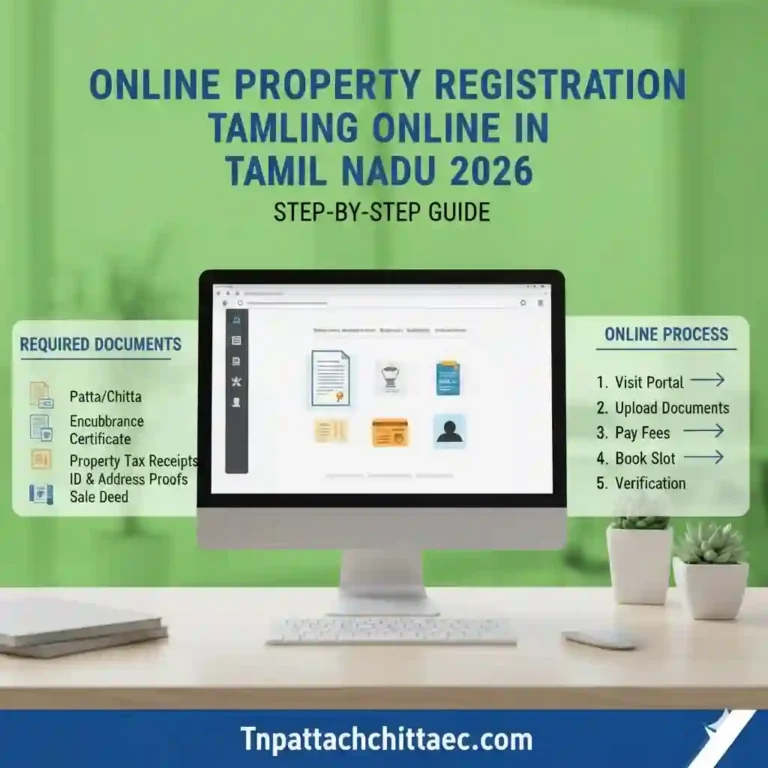
Complete Document Checklist for Property Registration in Tamil Nadu 2026
While Aadhaar + PAN and the Encumbrance Certificate are the two mandatory documents, you will also need to carry the following supporting documents for a complete and smooth registration:
| Document | Purpose | Mandatory? |
|---|---|---|
| Aadhaar Card | Identity verification | Yes |
| PAN Card | Financial transparency | Yes |
| Encumbrance Certificate (EC) | Property legal history | Yes |
| Sale deed / Agreement | Transaction record | Yes |
| Patta / Chitta extract | Land ownership record | Yes |
| Property tax receipt | Latest payment proof | Yes |
| Stamp duty payment receipt | Fee verification | Yes |
| Passport-size photographs | SRO requirement | Yes |
| Power of Attorney (if applicable) | Authorized representative | If applicable |
| Bank NOC | Release of mortgage | If mortgaged |
How to Register Property on TNREGINET in 2026 — Full Process
Once you have both mandatory documents and all supporting records ready, the property registration process on TNREGINET follows these steps:
- Visit tnreginet.gov.in and log in to your account
- Navigate to Property Registration under Services
- Enter complete property details including survey number, Patta/Chitta information, buyer and seller details
- Upload all required documents including EC, identity proof, and sale deed
- Check the TNREGINET Guideline Value for your property to calculate the correct stamp duty
- Pay stamp duty and registration fees online through the TNREGINET payment gateway
- Book your appointment at the nearest Sub-Registrar Office (SRO)
- Visit the SRO on your scheduled date with original documents and Aadhaar-linked mobile for OTP verification
- Complete biometric or in-person verification as required
- Receive your registered document — a digital copy will be available on the TNREGINET portal
Common Mistakes to Avoid
Many property registrations in Tamil Nadu face delays or rejection because of avoidable errors. Here are the most common mistakes and how to avoid them:
- Submitting an EC for too short a period — always go back at least 15 years
- Name mismatch between Aadhaar and sale deed — ensure all names are identical
- Not checking the TNREGINET Guideline Value before registration — paying below guideline value can trigger reassessment
- Forgetting to link Aadhaar with a mobile number — OTP verification fails without this
- Using an outdated EC — download a fresh EC within 30 days of registration
Frequently Asked Questions
Q: Are Aadhaar and PAN both compulsory for property registration in Tamil Nadu?
Yes. From 2026, both Aadhaar and PAN are mandatory for all parties involved in a property transaction — buyer, seller, and witnesses where applicable.
Q: Can I download the Encumbrance Certificate for free from TNREGINET?
Yes. You can view EC online for free on TNREGINET. A nominal fee may apply for the official downloadable PDF in some cases, depending on the period and SRO.
Q: How long does it take to get an EC from TNREGINET?
Instantly — the EC is generated and available for download on the same session once you submit the correct property details.
Q: What happens if my EC shows an old mortgage that has been cleared?
If a mortgage has been cleared by the bank but not yet updated in the records, you will need to submit a No Objection Certificate (NOC) from the bank along with the EC at the time of registration.
Q: Is the TNREGINET-downloaded EC accepted by banks for home loan processing?
Yes. EC downloaded from TNREGINET is an official government document and is accepted by all nationalized and private banks for loan processing and property due diligence.
Conclusion
The two mandatory documents for property registration in Tamil Nadu 2026 — Aadhaar + PAN Card for identity verification, and the Encumbrance Certificate (EC) from TNREGINET — are not just bureaucratic requirements. They are your best protection against property fraud, disputed ownership, and costly legal battles.
Before you sign any sale agreement or visit any Sub-Registrar Office, make sure both documents are ready, accurate, and updated. Download your EC directly from TNREGINET, verify that it shows a clean property history, and ensure your Aadhaar details match all other documents in the transaction.
Tamil Nadu’s TNREGINET portal makes this entire process fast, digital, and completely accessible from your home. Use it to your advantage and make your property journey in 2026 smooth, legal, and worry-free, Two Mandatory Documents for Property Registration.
For more step-by-step guides on TNREGINET, EC View, Patta Chitta, Guideline Value, and Tamil Nadu property registration services, visit tnpattachittaec.com — your trusted independent resource for Tamil Nadu land records.