
Cockroach Janta Party India: 20M Youth Protest Surge 2026
The Cockroach Janta Party India did not start in Parliament. It started with one judge, one sentence, and millions of young Indians who had been waiting for exactly this moment.
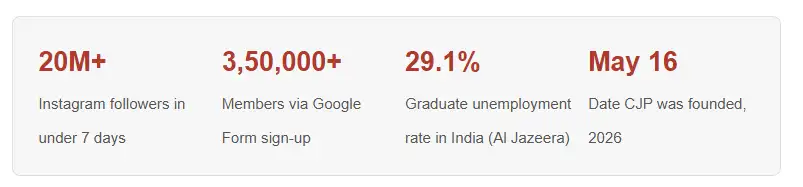
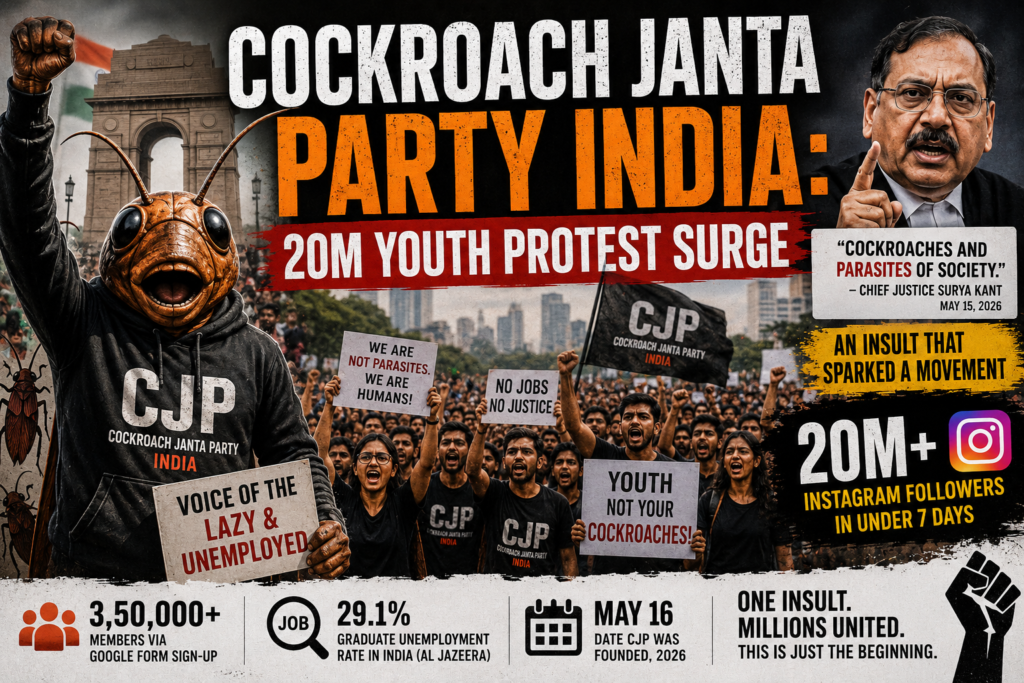
20M+Instagram followers in under 7 days
3,50,000+Members via Google Form sign-up
29.1%Graduate unemployment rate in India (Al Jazeera)
May 16 Date CJP was founded, 2026
What Is the Cockroach Janta Party India?
The Cockroach Janta Party India, or CJP, is a satirical political movement founded on May 16, 2026. It is not a registered political party. It does not contest elections. Yet within one week, it had more Instagram followers than India’s ruling party.
The name is a deliberate play on the BJP, Bharatiya Janata Party, which translates to “Indian People’s Party.” Replace “Bharatiya” with “Cockroach” and you get the joke. But behind the joke is real anger.
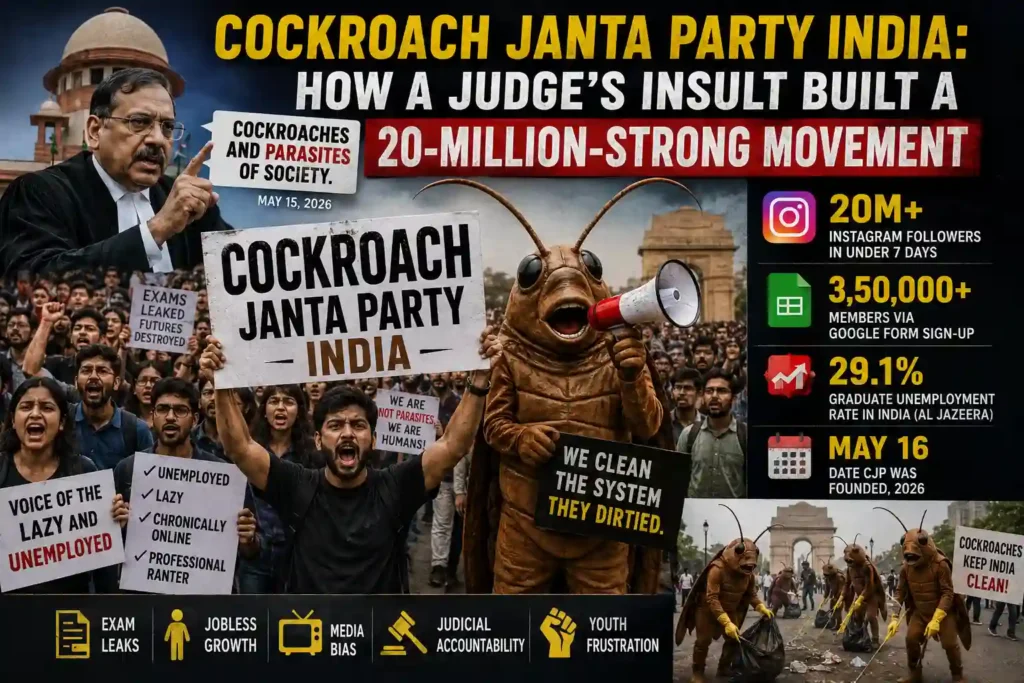
The Cockroach Janta Party India describes itself as the “Voice of the Lazy and Unemployed.” Its four-point membership criteria: you must be unemployed, lazy, chronically online, and able to rant professionally. Thousands across Mumbai local train coaches, Delhi metro carriages, Bengaluru tech parks, and Faisalabad-border towns in Punjab did not just laugh. They signed up.
The Judge Who Accidentally Started It All
On May 15, 2026, inside a Supreme Court hearing room in New Delhi, Chief Justice of India Surya Kant made a remark that would change the week. He compared unemployed young people who criticize institutions to “cockroaches” and “parasites of society.”
He later clarified that he was only targeting people with fake degrees who had entered professions illegally. But the damage was done. His words spread to every WhatsApp group, every college mess, every chai stall from Connaught Place to Chandni Chowk.
Young Indians in 2026 are not in a mood for clarifications. They have watched exam paper after exam paper get leaked. They studied for NEET in 2024 only to see the question papers appear online before the test. They send out hundreds of job applications and hear nothing back.
“Five years ago, nobody was ready to speak up against Modi or the government. The times are changing.” — Abhijeet Dipke, CJP Founder
Who Founded the Cockroach Janta Party India?
Abhijeet Dipke is 30 years old. He is a political communications strategist who previously worked with the Aam Aadmi Party, the political movement born out of India’s 2012 anti-corruption protests at Jantar Mantar, New Delhi. He was studying public relations at Boston University in the United States when Chief Justice Kant made his remarks.
On the evening of May 15, Dipke posted a single question to his followers: “What if all cockroaches come together?” By morning, the response was overwhelming. He launched a website, set up a Google Form for registrations, and created social media accounts.
Within 48 hours, the Cockroach Janta Party India had 40,000 registered members. Within 72 hours, the Instagram account had 3 million followers. By May 22, it crossed 20 million. The BJP’s own Instagram page, built over years, has about 10 million followers.
The Manifesto: Funny, But Not Really a Joke
The CJP manifesto reads like satire. But strip away the jokes and you find a direct list of real grievances. It targets voter manipulation allegations against the Modi government. It calls out a corporate media that critics say has become too close to power. It questions the practice of appointing retired judges to government positions.
The CJP also raised the NEET exam scandal of 2024. Millions of medical aspirants from small towns, from cities like Patna and Bhopal and Jaipur, spent family savings on coaching and preparation. The paper leaked. Their dreams didn’t just get delayed. For many, they ended.
India produces over 8 million graduates every year. The unemployment rate among graduates stands at 29.1 percent according to Al Jazeera. That means nearly 1 in 3 young Indians with a degree cannot find a job. Youth unemployment in the double digits. That is the soil in which the Cockroach Janta Party India grew.
Going Offline: Cockroach Costumes on Indian Streets
The Cockroach Janta Party India did not stay on phone screens. Supporters took the protest offline. In cities across India, CJP volunteers dressed in cockroach costumes and participated in public clean-up drives. It was symbolic. They were doing the unglamorous work that nobody notices. Just like cockroaches do, as one supporter put it.
In Delhi, volunteers in insect costumes were spotted near India Gate. In Mumbai, similar gatherings happened near Marine Drive. In Hyderabad, around Hussain Sagar lake. The movement, born on Instagram, was now walking down real roads, on real pavements, in front of real eyes.
This matters. Most Indian online movements stay online. The CJP was different. It made itself visible in physical spaces that politicians cannot ignore.
The Government Blocked It. That Made It Bigger.
On May 21, 2026, India’s Ministry of Electronics and Information Technology blocked the CJP’s X (formerly Twitter) account. The stated reason: threats to national security and sovereignty, based on inputs from the Intelligence Bureau.
The CJP’s website was blocked shortly after.
Congress MP Shashi Tharoor called the block “disastrous” and “deeply unwise.” He wrote that there should be an outlet for youth frustration in a democracy. Blocking satire, he argued, is not governance. It is panic.
Dipke posted publicly that a fake account, @Cockroach4India, had appeared on X and was impersonating the movement. He alleged it was created by the ruling party’s IT cell. Whether or not that is true, it showed how seriously the political establishment was taking a movement that called itself lazy.
“It is a section of the urban middle class suddenly discovering that the system they watched brutalise others for years can humiliate them too.” — Instagram user, 15,000+ likes
What Do Critics Say?
Not everyone is celebrating the Cockroach Janta Party India. Some critics argue it is “meme politics.” They say young people with smartphones and time are playing at activism while those who are truly suffering, daily wage workers, migrant workers at Kashmere Gate bus stand, students from Bihar cramming in dimly lit rooms in Mukherjee Nagar, have no time for viral movements.
One Instagram post with over 15,000 likes summed it up sharply. The writer said the CJP is the urban middle class discovering what the system can do to them, after years of watching it do the same to others. It is a fair critique. The digital divide in India is real. Not every frustrated young Indian is on Instagram.
Others point out that the CJP offers no real political solutions. Its manifesto is funny. But funny does not fix the exam system. Funny does not create jobs. Funny does not hold a judge accountable.
Why the Cockroach Janta Party India Still Matters
India has the largest youth population on earth. About 367 million people are between ages 15 and 29. More than a quarter of India’s entire population is Gen Z. When this many young people feel unheard, something breaks. Or something builds.
South Asia has seen what happens when youth anger reaches a tipping point. In Bangladesh in 2024, a student-led protest movement of tens of millions toppled Prime Minister Sheikh Hasina. She fled to India. In Nepal, youth activism brought down the government last year.
India is a much larger, more complex democracy. This movement is not going to topple anything tomorrow. But it is a clear signal. Young Indians are watching. They are counting. And now they are organizing, even if in cockroach costumes.
The movement is also part of something bigger. People are asking questions about institutional accountability in India that were not being asked this loudly even five years ago. About the judiciary. About media freedom. About economic data. About who wins and who loses in modern India.
What Happens Next for the CJP?
Abhijeet Dipke has said he is working on a plan to keep the movement going sustainably. The Cockroach Janta Party India is not registered with the Election Commission of India. That means it cannot contest elections, at least not yet.
But it is building something important: a generation of politically aware young Indians who are not afraid to use humor as a weapon. They have shown that you can reach 20 million people in less than a week without a party office, without a budget, and without a single press conference on Lutyen’s Delhi lawns.
The cockroach, history’s most resilient creature, is now India’s most unexpected political mascot. Whether the CJP evolves into something with real electoral impact, or stays as a cultural movement, it has already done one thing no protest in recent memory has managed: it made Indian politics feel like it belongs to young people again.
Key Facts: Cockroach Janta Party India at a Glance
Founded: May 16, 2026, by Abhijeet Dipke, New Delhi/Boston University
Trigger: Chief Justice Surya Kant comparing unemployed youth to cockroaches and parasites on May 15, 2026
Followers: Over 20 million on Instagram within 7 days; over 350,000 members via Google Form
Status: Not a registered political party under the Election Commission of India
Government Response: X account and official website blocked by MeitY citing national security, May 21, 2026
Core Issues: Graduate unemployment at 29.1%, NEET and exam paper leaks, judicial accountability, media freedom
Cockroach Janta Party IndiaGen Z IndiaIndia Youth ProtestCJP 2026India PoliticsAbhijeet DipkeYouth Unemployment India
Sources & References:
1. Wikipedia: Cockroach Janta Party
2. CBS News: Rapid rise of Cockroach Janta Party spooks India’s leaders
3. CNN: India’s Gen Z and the Cockroach Janta Party
4. Al Jazeera: Top Indian judge’s comment sparks satire and protest
5. NBC News: India’s Cockroach Janata Party began as a joke. Then millions joined.
6. Business Today: Cockroach Janta Party website blocked after X and Instagram ban
7. The Quint: Youth Anger, Judicial Insult and Why Revolution Won’t Be a Google Form