How Patta Chitta Can Be Used to Apply for Govt Land Schemes
If you own land in Tamil Nadu and want to apply for a government housing or land scheme, Patta Chitta is not optional. It is the starting point. Without it, your application goes nowhere.
What Is Patta Chitta and Why It Matters
Patta Chitta is a two-part official land record issued by the Tamil Nadu government. Patta is the ownership document. Chitta is the land register that shows survey number, area, soil type, and land use.
Together, they prove that a piece of land legally belongs to you. Whether your plot is near Coimbatore’s Saravanampatti area, a village near Madurai’s Melur taluk, or a suburb along Chennai’s Old Mahabalipuram Road, these two records are the bedrock of your land identity.
The Tamil Nadu government merged both documents into a single unified record in 2015 through the e-Patta Chitta system under TNREGINET and the Meeseva portal. Today you can get it online in minutes. That shift made Patta Chitta even more central to government scheme applications.
Official Source
You can access and download your Patta Chitta at eservices.tn.gov.in, the official Tamil Nadu e-Services portal managed by the Revenue Department.
Government Land Schemes That Require Patta Chitta
Several central and state government schemes ask for Patta Chitta as a mandatory document. Here is a breakdown of the most important ones.
| Scheme | Issuing Authority | Why Patta Chitta Is Needed |
|---|---|---|
| PMAY-G (Pradhan Mantri Awas Yojana – Gramin) | Ministry of Rural Development | Proves land ownership for house construction |
| TNHB Housing Schemes | Tamil Nadu Housing Board | Needed for plot allotment and resale verification |
| CM Housing Scheme (Kalaignar / Amma) | TNSCB (Slum Clearance Board) | Confirms site ownership for beneficiary selection |
| Land Regularization Scheme (LRS) | Tamil Nadu Revenue Dept. | Core document for encroachment regularization |
| Agricultural Subsidy Schemes | TN Agriculture Dept. | Verifies cultivable land for input subsidies |
| SC/ST Land Distribution Scheme | Adi Dravidar Welfare Dept. | Confirms government-assigned land to beneficiaries |
Each of these schemes requires proof that you hold the land in your name. Patta Chitta is the only document that satisfies this requirement across both rural taluk offices and urban corporation limits.
How to Get Your Patta Chitta Before Applying
You cannot apply for a government scheme with an outdated or missing Patta Chitta. Get a fresh copy first. Here is the exact process.
Online Method (Fastest)
- 1Go to eservices.tn.gov.in. Click on “View Patta and FMB/Chitta/TSLR Extract.”
- 2Select your district, taluk, village, and survey number. This matches the details on your sale deed or earlier Patta copy.
- 3Submit the form. The system shows your Patta Chitta on screen. Download and print it as a PDF.
- 4For a digitally signed certified copy, pay Rs. 100 through the portal. This version is accepted by all government offices.
Offline Method (Through Tahsildar Office)
Visit your local Tahsildar office. In Chennai, that means offices at Royapuram, Mylapore, or Perambur depending on your zone. In Coimbatore, head to the Tahsildar office near Gandhipuram or the Collectorate on Race Course Road.
Submit Form A with your survey number and village details. Pay Rs. 30 to Rs. 60 as fees depending on the type of extract. You receive the document within 2 to 3 working days.
Local Tip
In Madurai, the District Revenue Office near Goripalayam handles Patta corrections and mutation requests. For Tirunelveli, the Collectorate on Court Road is your point of contact for land records disputes.
Step-by-Step: Using Patta Chitta in PMAY-G Application
PMAY-G is the most widely applied central scheme in Tamil Nadu’s rural blocks. Let us walk through how Patta Chitta fits into the process.
- 1Check your name on SECC list. The Socio-Economic and Caste Census 2011 list determines eligibility. Your village panchayat office on the main road of your panchayat headquarters has this list.
- 2Get your Patta Chitta ready. The land on the Patta must be in your name. If it is in a parent’s name, mutation is needed first. Mutation is done at the Tahsildar office.
- 3Submit documents to the Block Development Officer (BDO). In districts like Villupuram, Kallakurichi, and Tiruvannamalai, BDO offices are located near the collectorate junction. Attach Patta Chitta along with Aadhaar, ration card, and income certificate.
- 4Field verification happens. A revenue inspector visits your plot and checks survey boundaries. Patta Chitta helps them identify the exact survey number and acreage on the ground.
- 5Sanction letter issued. Once verified, the sanction letter arrives. Construction must start within 6 months to avoid cancellation.
Common Errors in Patta Chitta That Reject Your Application
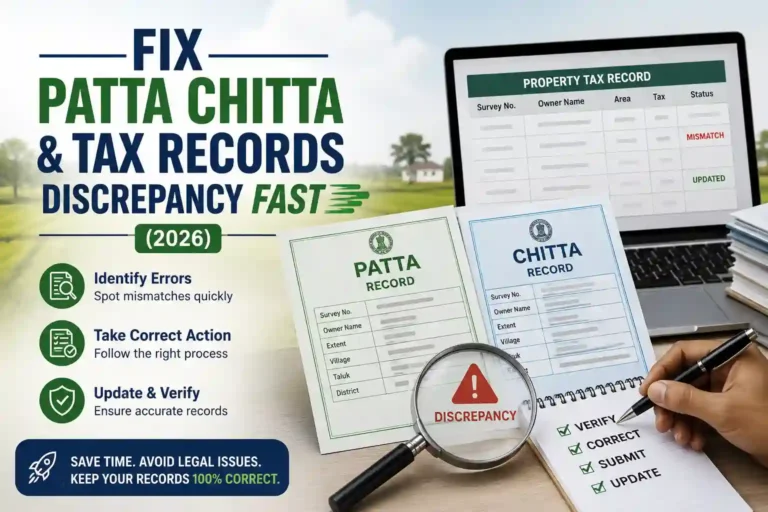
Many scheme applications get rejected not because of ineligibility but because of errors in the Patta Chitta. Watch for these issues before submitting.
- Name mismatch between Patta and Aadhaar card. Even a spelling difference like “Murugan” vs “Murugesan” can cause delays.
- Survey number discrepancy between the sale deed and the current Patta. This happens after land consolidation surveys.
- Land classified as poramboke on Chitta. Poramboke land is government land. You cannot build on it under any housing scheme.
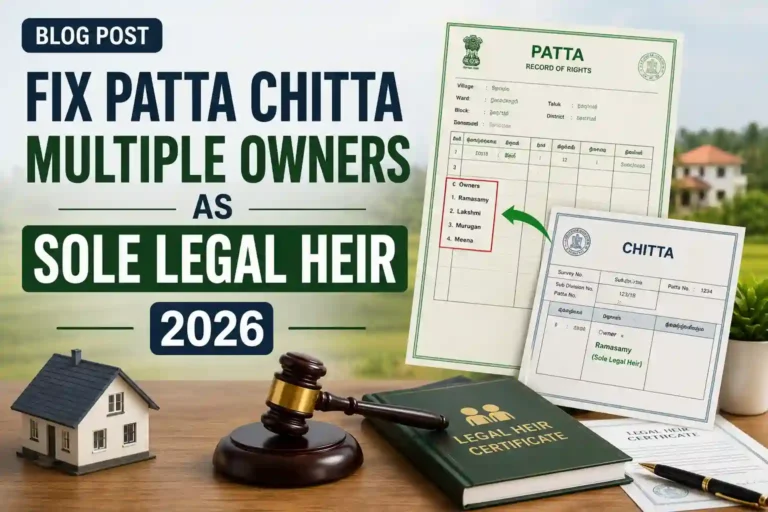
- Multiple owners listed without a partition deed. All co-owners must give consent, or the scheme application gets stalled.
- Outdated Chitta showing old land use. If the land use was changed from agricultural to residential, the updated FMB sketch is needed too.
How to Fix Errors
Name corrections in Patta are handled by the Tahsildar. Survey number corrections go to the Revenue Divisional Officer (RDO). In Chennai, RDO offices are located in areas like Anna Nagar and Tambaram. Processing takes 15 to 45 days depending on the issue.
Patta Chitta for TNHB and TNSCB Housing Schemes
The Tamil Nadu Housing Board runs plot and apartment allotment schemes regularly. The TNSCB manages slum clearance and resettlement colonies. Both agencies demand Patta Chitta during allotment, resale, or grant of formal title.
For TNHB applicants in cities like Salem, Erode, or Trichy, the Patta Chitta of the plot you currently own plays a key role. It establishes that you do not already own another government-allotted house, which is a condition for fresh allotment.
For TNSCB resettlement colonies near Chennai like Kannagi Nagar in Sholinganallur or Perumbakkam off the Old Mahabalipuram Road, residents need Patta Chitta to apply for the formal pattas issued after occupancy. Without this, they cannot sell, mortgage, or improve their units legally.
Patta Chitta and Agricultural Land Schemes
Farmers applying for crop insurance under PMFBY (Pradhan Mantri Fasal Bima Yojana) need Patta Chitta to prove land holding. Banks and insurance companies tie the survey number to the crop area insured.
The PM-KISAN scheme pays Rs. 6000 per year to eligible farmers. But the beneficiary database is built on land records. Your Chitta must show you as an active cultivator, not just an owner, for some sub-schemes.
In the Cauvery delta region covering Thanjavur, Tiruvarur, Nagapattinam, and Mayiladuthurai, land records are especially critical. Canal water allocation and irrigation board disputes are all traced back to survey numbers in the Chitta.
Key Reference
The Tamil Nadu Land Reforms Act, 1961 and the Tamil Nadu Patta Passbook Act, 1983 are the legal foundation for Patta Chitta rights. For detailed legal text, refer to the Tamil Nadu Revenue Department’s official disclosure.
Land Regularization Scheme: Patta Chitta Is the Core Document
The Tamil Nadu government launched several Land Regularization Scheme rounds to help people living on unapproved layouts. People in areas like Ambattur, Poonamallee, and Chromepet in Chennai’s western and southern corridors benefited from these.
To apply for regularization, you must submit Patta Chitta showing the survey number, along with tax receipts and proof of occupation. The regularization committee verifies that the land is not classified as water body, forest, or government reserve.
Once regularization is granted, a fresh Patta Chitta is issued in the applicant’s name. This becomes the foundational document for all future scheme applications, property loans, and legal title claims.
Documents You Need Along with Patta Chitta
Patta Chitta alone is not enough. Every scheme needs a document bundle. Here is what you typically need.
| Document | Where to Get It |
|---|---|
| Patta Chitta (certified copy) | eservices.tn.gov.in or Tahsildar office |
| Aadhaar Card | UIDAI.gov.in or nearest Aadhaar enrolment centre |
| Ration Card (family members) | Fair Price Shop or tnepds.gov.in |
| Income Certificate | VAO or Tahsildar office in your taluk |
| Community Certificate (SC/ST/OBC) | Tahsildar office or e-Sevai centre |
| FMB Sketch (Field Measurement Book) | Survey Settlement Office or TNREGINET |
| Sale Deed / Gift Deed | Sub-Registrar Office where land was registered |
FAQs |
Can I apply for PMAY if the Patta is in my father’s name?
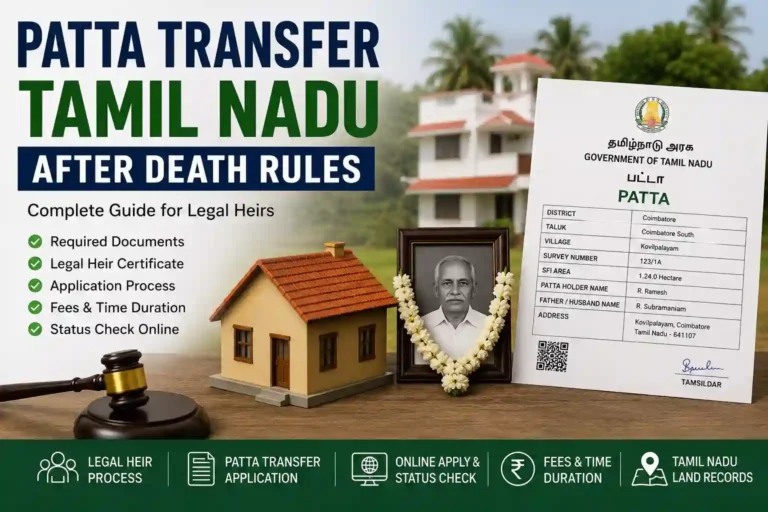
No. You need to first get the Patta mutated in your name through the Tahsildar office. Submit the legal heir certificate and a gift deed or settlement deed if needed. Mutation takes 15 to 30 days in most taluks.
Is the online Patta Chitta printout accepted by government offices?
A digitally signed copy from eservices.tn.gov.in is legally valid. Pay Rs. 100 for the certified version. Plain printouts without digital signature may not be accepted in all offices, especially district collectorates.
My land is in a village that merged with a municipality. Which office handles my Patta Chitta?
After merger, land records shift from the Revenue Department to the Town Survey land records managed by the municipality. Contact the Town Survey office or the RDO for your area. In Chennai, newly merged zones are handled by the Greater Chennai Corporation’s revenue wing.
What if my land has no survey number at all?
This usually happens in very old layouts in areas like Pulianthope or Elephant Gate in north Chennai, or in villages with disputed or unmapped parcels. Contact the District Survey Superintendent. A fresh survey and numbering will be done before Patta Chitta can be issued.
How often should I update my Patta Chitta?
Update it every time there is a change in ownership, land use, or area. Before applying for any government scheme, get a fresh copy that is not older than 6 months. This avoids rejection on technical grounds.
Bottom Line
Patta Chitta is not just paperwork. It is the legal identity of your land. Every government housing, agricultural, or regularization scheme in Tamil Nadu runs on it.
Get your Patta Chitta updated before you apply. Check for errors. Make sure the name, survey number, and land use match your current situation. A clean Patta Chitta is the difference between a scheme that works for you and one that stalls at the desk.
Start at eservices.tn.gov.in right now. It takes less than 10 minutes to check your records.