
What to Do If Multiple Patta Numbers Exist for the Same Land
You check the government records and find two Patta numbers pointing to the same piece of land. Or a buyer’s lawyer flags a duplicate Patta entry before your sale. Or worse — a stranger shows up claiming their Patta covers the same survey number as yours.
This situation is more common than most landowners realize. And while it looks alarming at first, it is almost always fixable — if you act correctly and promptly.
This guide explains exactly why multiple Patta numbers appear for the same land, what legal risks you face if you ignore it, and the complete step-by-step process to resolve it through the Revenue Department.
What Is a Patta and Why Does the Number Matter?
A Patta (also called a “Record of Rights” or A-Register Extract) is a legal document issued by the state Revenue Department. It officially records who owns a particular piece of land. In Tamil Nadu, it is known as Patta Chitta — a combined document that proves both ownership (Patta) and land classification (Chitta).
Every Patta carries a unique Patta number. That number links your name, your survey number, your land’s area, soil type, water resource, and tax details — all in one official record maintained by the Tahsildar.
Think of the Patta number as your land’s government identity card. Just as no two people can legally hold the same Aadhaar number, no two separate parcels of land should carry the same active Patta number within the same village or taluk.
When two Patta numbers map to the same physical land, the government’s records have a conflict. Banks cannot process loans against it. Buyers walk away. Disputes become harder to resolve in court. The land is effectively frozen — legally alive, practically unusable.
Why Do Multiple Patta Numbers Exist for the Same Land?
Understanding the root cause speeds up the fix. Multiple Patta Numbers. Here are the seven most common reasons this happens:
1. Digitization Errors During Computerization Between 1981 and 1989, Tamil Nadu ran the UDR (Updating Data Registry) programme to shift land records from paper to digital. Many older records were entered twice, mis-keyed, or duplicated during data migration. Properties registered under one survey number were sometimes entered under a second Patta number in the new system — and both entries survived.
2. Land Subdivision Without Proper Cancellation When a large plot is split into sub-plots — Survey No. 123 becoming 123/1, 123/2, 123/3 — each portion should receive a new individual Patta, and the parent Patta should be closed. If the original Patta number was never cancelled, it continues to exist alongside the new subdivision numbers.
3. Inherited Land With Multiple Legal Heirs When a landowner passes away, the Patta is transferred to all legal heirs, creating a Joint Patta in their names. But if individual heirs also apply separately for their own Patta entries — without completing a formal partition deed — multiple Patta numbers can emerge for the same undivided land.
4. Joint Purchase Confusion When two or more people jointly purchase land under a single sale deed, they receive a Joint Patta listing all names. If one party later applies for an individual Patta without a registered partition, the system may generate a new number without cancelling the original.
5. Old Patta Not Closed After Transfer. When land is sold and the new owner gets a fresh Patta in their name, the previous owner’s Patta should be cancelled. Multiple Patta Numbers. If the revenue office fails to update the mutation properly, both old and new Patta numbers continue to show in government records.
6. Survey Discrepancies and FMB Errors The Field Measurement Book (FMB) is the government’s land boundary map. When actual field measurements differ from recorded dimensions — even by a few cents — surveyors sometimes create a new Patta entry rather than correcting the existing one. This leaves two numbers alive for essentially the same land.
7. Clerical Errors at the Taluk Office Manual data entry errors — wrong name spelling, transposed survey numbers, incorrect subdivision codes — can lead to duplicate records. A Patta registered under Survey No. 265/40 when it should be 265/2B is a real example seen in revenue offices across Tamil Nadu.
What Are the Legal Risks of Ignoring This?
This is not a paperwork problem you can defer. Duplicate Patta numbers create serious, measurable legal and financial risks:
- You cannot sell the land. Buyers and their advocates will reject the sale until records are clean. Most banks refuse to release a home loan if Patta records show any conflict.
- Ownership disputes escalate. A duplicate Patta number can be exploited by encroachers or fraudulent claimants to assert competing ownership rights.
- Government acquisition notices may go to the wrong party. If the government acquires your land for road widening or public use, the notice and compensation may be directed to whoever holds the other Patta — not you.
- Property tax confusion. You may find yourself paying tax on one Patta number while dues accumulate on the other, leading to arrears and penalties.
- Court cases become expensive. What starts as a revenue correction can become a civil dispute if left unresolved long enough to attract fraudulent claims.
The sooner you act, the simpler and cheaper the fix.
Step-by-Step: How to Resolve Multiple Patta Numbers for the Same Land
Step 1 — Verify the Records Online Before Anything Else
Start at home. Check the official government portal before visiting any office.
In Tamil Nadu, go to eservices.tn.gov.in. Select “View Patta & FMB / Chitta / TSLR Extract.” Enter your District, Taluk, Village, and Survey Number. Note every Patta number that appears against your survey number or your name.
Cross-check using both the survey number and your name to catch all entries. Download and print copies of every result — including conflicting ones. This becomes your evidence file.
For other states, use your respective land records portal — Bhoomi for Karnataka, Dharani for Andhra Pradesh and Telangana, Bhulekh for Uttar Pradesh, and similar portals.
Step 2 — Gather Your Complete Document Set
Walk into any revenue office with an incomplete file and expect delays. Prepare all of these before your first visit:
- Original Sale Deed or Title Deed (the registered document from the Sub-Registrar’s Office)
- All existing Patta documents — both the one you hold and any printouts of conflicting entries
- Encumbrance Certificate (EC) — covers full ownership and transaction history; request at least 30 years of history
- FMB Sketch — the Field Measurement Book map showing your land’s exact boundaries
- Property tax receipts — recent and historical, showing your name as payer
- Aadhaar card or other government ID
- Legal heir certificate or succession certificate (if the land was inherited)
- Partition deed (if applicable — if the land was split among co-owners)
- Power of Attorney (if you are acting on behalf of another owner)
Make at least four certified copies of each document. You will need to submit originals or attested copies at different stages.
Step 3 — Visit the Village Administrative Officer (VAO)
The VAO is the ground-level authority for land records in your village or locality. Start here.
Explain the discrepancy clearly. Show both Patta numbers. The VAO will check local records and physically verify your land. This officer knows the neighbourhood — they can often identify whether the duplicate arose from a data entry error, an unclosed old Patta, or a genuine dispute.
The VAO will either issue a field verification note supporting your claim or escalate the case to the Revenue Inspector (RI). Get written acknowledgment of your visit and any notes the VAO records.
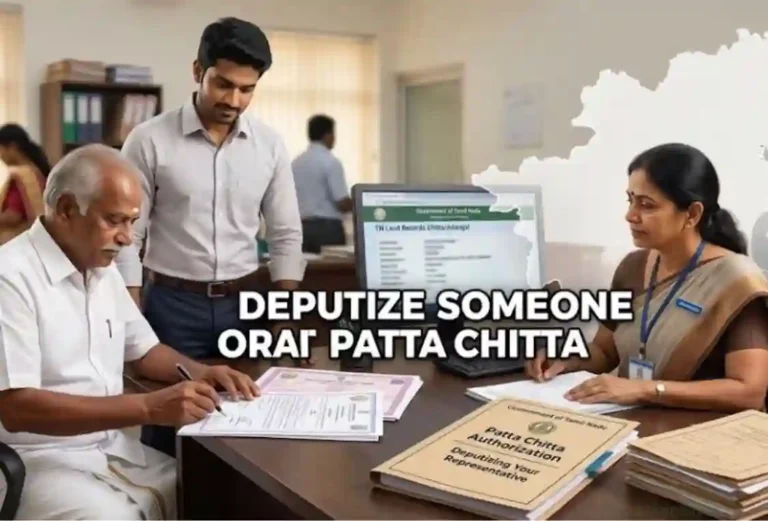
Step 4 — File a Formal Petition at the Tahsildar’s Office
The Tahsildar is the primary authority with legal power to cancel Patta entries, order corrections, and issue new or merged records. Your petition must be in writing and must include:
- Your full name and address
- Details of the land — District, Taluk, Village, Survey Number, Subdivision Number
- Both Patta numbers with an explanation of the conflict
- What you are requesting — cancellation of the duplicate, correction of an error, or merger of records
- Certified copies of all supporting documents
- Do If Multiple Patta Numbers Exist for the Same Land
Submit the petition at the Taluk Office counter and collect the acknowledgment receipt with a date stamp. This receipt is your proof of filing.
If the correction involves a data entry error in the sale deed itself (such as a wrong survey number), you may also need to execute a Rectification Deed — signed by both buyer and seller and registered at the original Sub-Registrar’s Office. This corrects the source document before the revenue record can be updated.
Step 5 — Field Survey and Boundary Verification
After receiving your petition, the Tahsildar will typically depute a government surveyor to inspect the land. This is called a field measurement or demarcation exercise.
During this visit, the surveyor will:
- Physically measure the land boundaries on the ground
- Match field dimensions against the FMB Sketch and A-Register entries
- Confirm which Patta number correctly corresponds to the physical land parcel
- Document any surplus or shortage in area compared to records
- Record the Chekkupanthi — the boundary description noting the neighbouring plots and landmarks around your land (used in Tamil Nadu)
Be present during the survey. Point out your boundaries clearly. Have your FMB sketch with you. Multiple Patta Numbers. If neighbouring landowners are cooperative, their presence can speed up the process.
Step 6 — Tahsildar Issues Correction Order
Based on the survey report and your petition, the Tahsildar will issue a formal order. This order will:
- Confirm the correct Patta number for your land
- Cancel the duplicate or incorrect Patta entry
- Update the A-Register (revenue record) with corrected details
- Direct the VAO to update local records accordingly
This step can take anywhere from 15 days to several months, depending on the complexity of your case, how busy the taluk office is, and whether any disputes arise during the process. Follow up regularly — at least once every two weeks — in person or through the e-Sevai status portal.
Step 7 — Confirm the Update Online and Get a Fresh Extract
Once the order is issued, wait 7–10 working days for the records to update in the system. Then log in to the state e-services portal again and download a fresh Patta/Chitta extract using your survey number.
Verify that:
- Only one Patta number appears for your land
- Your name is correctly recorded as owner
- The survey number, subdivision number, land area, and classification are accurate (Multiple Patta Numbers)
- The old duplicate number no longer appears
Keep a certified copy of this corrected extract in a safe place. This becomes the clean record for all future transactions.
What If Co-Owners Refuse to Cooperate?
This is the most difficult scenario. If multiple Patta numbers exist because of an unresolved joint ownership dispute — and one or more co-owners refuse to participate in correction or partition — you have three escalating options:
Mediation through local revenue authorities. The Tahsildar can call all parties together and attempt administrative resolution. This is the fastest path when relationships are not completely broken.
Register a Partition Deed. If all co-owners agree on how to divide the land, a Partition Deed can be drafted, signed, and registered at the Sub-Registrar’s Office. Once registered, each co-owner applies for their own individual Patta based on their defined share.
File a Civil Suit for Partition. If a co-owner refuses to cooperate, you can file a partition suit in the jurisdictional civil court. The judge will summon all parties, review the ownership documents and deeds, and issue a decree defining each person’s share. The court order can then be presented to the Tahsildar to issue separate Pattas — with or without the uncooperative party’s consent.
Documents and Fees
| What You Need | Where to Get It |
|---|---|
| Patta/Chitta Extract | eservices.tn.gov.in (free download) |
| Encumbrance Certificate | tnreginet.gov.in (~₹100–₹200) |
| FMB Sketch | eservices.tn.gov.in or Taluk Office |
| Patta Correction Petition | Draft yourself; submit at Taluk Office |
| Rectification Deed | Lawyer + Sub-Registrar’s Office (stamp duty applicable) |
| Field Survey | Ordered by Tahsildar; nominal government fee |
| Patta Transfer (Mutation) | e-Sevai Centre (~₹100–₹300) |
People Also Ask — Answered Directly
Can two different lands have the same Patta number?
No. Within a village or taluk, each Patta number must be unique. If two land parcels show the same number, it is a records error that must be corrected at the Tahsildar’s office.
Can I sell land if it has multiple Patta numbers?
Practically, no. Any competent buyer’s advocate will flag the discrepancy, and banks will not sanction loans against unclear Patta records. Resolve the issue before attempting a sale.
How long does Patta correction take in Tamil Nadu?
Simple clerical corrections typically take 15–30 days. Cases requiring a field survey can take 2–4 months. Disputed cases involving co-owners may take longer if court proceedings are needed.
What is a Rectification Deed and when do I need one?
A Rectification Deed is a registered legal document that corrects errors in an original sale deed — such as a wrong survey number. It must be signed by all original parties and registered at the same Sub-Registrar’s Office. It is needed when the sale deed itself contains the error, not just the revenue record.
Is my land safe if the other Patta number is in someone else’s name?
Your registered sale deed remains legally valid — it is the primary proof of ownership under Indian law. However, a competing Patta in someone else’s name is a serious risk. It can lead to claims, disputes, and complications in future transactions. Correct it without delay.
Can I do Patta correction online?
In Tamil Nadu, Patta transfer (mutation) can be applied online at eservices.tn.gov.in. However, Patta corrections and cancellation of duplicate entries still require a physical petition at the Taluk or RD
The 7 Steps at a Glance
Multiple Patta Numbers Exist for the Same Land.
- Verify both Patta numbers online at the state e-services portal
- Collect your full document set — sale deed, EC, FMB sketch, tax receipts
- Report the issue to your Village Administrative Officer (VAO)
- File a formal written petition at the Tahsildar’s Office
- Cooperate with the government field survey and boundary verification
- Obtain the Tahsildar’s correction order cancelling the duplicate
- Download a fresh Patta extract online to confirm the clean record
Final Word
A duplicate Patta number is not a sign that someone else owns your land. Multiple Patta Numbers In most cases, it is a paper error — created by outdated records, old digitization mistakes, or incomplete mutation processes. The Revenue Department has well-defined procedures to fix it.
What it does require is your attention, your documents, and persistent follow-up with the Tahsildar’s office. Do not wait for the problem to surface at the worst possible moment — during a sale, a loan application, or a legal dispute.
Act now. File the petition. Get the correction done. Your land deserves a clean record.