Patta Chitta Not Available Online? Here Are Your Options 2026
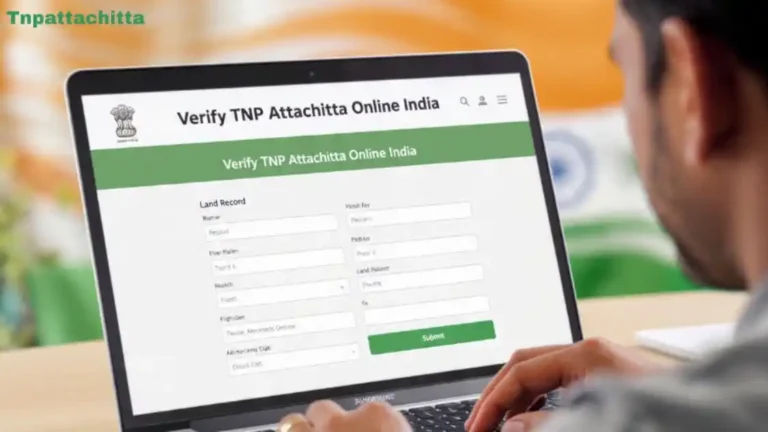
You enter the survey number. You fill in your district, taluk, and village. You hit submit. Then nothing. Or worse — a blank page.
This happens more often than people talk about. Patta Chitta records go missing online for several reasons. Your land might be in a pocket that hasn’t been fully digitized. There could be a pending transfer that hasn’t been updated. Or your property falls under a different classification like TSLR — and you’ve been searching in the wrong section all along.
Whatever the reason, you are not stuck. There are clear steps you can take right now.
Why Patta Chitta Might Not Show Up Online
Before running to the Taluk office, understand why the record isn’t appearing. The Tamil Nadu e-Services portal at eservices.tn.gov.in holds most rural land records. But the portal has known gaps.
Here are the common reasons:
Wrong land type selected. If your property is in a town or city area — say, near Anna Nagar in Chennai, or around Gandhipuram in Coimbatore — it falls under the Town Survey Land Register (TSLR). You won’t find it under the rural Patta Chitta section. You need to select the “Urban” option and look for the TSLR Extract instead.
Record not digitized yet. Tamil Nadu has digitized land records across 146 taluks, but older records — especially pre-1979 entries — may still exist only as physical registers at the VAO or Taluk office.
Patta transfer pending. If ownership changed after a sale, inheritance, or court order and no mutation was applied for, the new owner’s name won’t appear online. The old record may not even be searchable.
Typo or mismatched data. Even a single digit wrong in the survey number throws off the result. The same goes for village names — many districts in Tamil Nadu have villages with similar names across different taluks.
Try correcting these details first. If the record still doesn’t appear, move to the options below.
Option 1: Check the TSLR Extract for Urban Land
This is the most overlooked fix. Many people in Chennai, Madurai, Trichy, Salem, and Coimbatore search for rural Patta Chitta when their land is actually registered under the Town Survey Land Register.
The TSLR Extract is the official land ownership document for plots inside municipal corporation or town panchayat limits. It carries the same legal weight as Patta Chitta for urban areas.
To access it:
- Go to eservices.tn.gov.in
- Click on “View Patta & FMB / Chitta / TSLR Extract”
- Select Urban for Patta Chitta
- Enter your District, Town, Ward, Block, Survey Number, and Subdivision
If your plot is near areas like T. Nagar, Velachery, or Anna Salai in Chennai, or near Trichy Road in Coimbatore, this is almost certainly the document you need.
Option 2: Visit the Village Administrative Officer (VAO)
The VAO is your first point of contact for undigitized records. Every village in Tamil Nadu has a VAO who maintains physical land registers — the same registers that were used before the e-Services portal was built.
Bring these documents when you visit:
- Old sale deed or registered deed
- Previous property tax receipts
- Old Patta or Chitta copies if available
- Encumbrance Certificate (EC)
- Your Aadhaar card
The VAO can manually verify your survey number and ownership history. They can also initiate a request to update your record in the digital system if it’s missing.
If you’re near Madurai, the VAO offices in Tallakulam, Avaniyapuram, and Paravai have handled these requests frequently. In Chennai, areas like Ambattur, Sholinganallur, and Perumbakkam have older natham land records that required manual VAO intervention.
Option 3: Go to the Taluk Office Directly
The Taluk office is the next step up from the VAO. It holds certified copies of older records that were never uploaded to the portal Patta Chitta. These include records from the U.T.R. (Uniform Transfer of Records) program that ran between 1979 and 1986 across Tamil Nadu.
At the Taluk office, you can:
- Request a manual search of physical registers
- Get a certified copy of your Patta or Chitta
- File a written application if records need to be located from the District Revenue Office
- Apply for Patta transfer in person if the online portal isn’t working for your property
The Tahsildar at the Taluk office has the authority to issue certified land documents even when the digital portal has no record.
Option 4: Apply Through an E-Sevai Centre
If visiting the VAO or Taluk office feels complicated, E-Sevai centres offer a simpler path. These are government-run service centres spread across all districts in Tamil Nadu. They are the same centres that issue birth certificates, community certificates, and income certificates.
At an E-Sevai centre, a trained operator submits your request directly. A Patta transfer application filed at any Common Service Centre (CSC) costs just Rs. 60 per application. For record searches involving undigitized land, the operator sends your request for manual verification to the concerned revenue office.
This is especially helpful for NRIs, senior citizens, or anyone who finds the online portal confusing. The E-Sevai operator handles the technical steps on your behalf.
Option 5: Check the A-Register Extract
Sometimes the Patta Chitta isn’t searchable, but the A-Register still has your land details. The A-Register is a revenue record maintained by the VAO that contains survey number details, land area, ownership history, land type, and tax information.
You can access the A-Register online through the same e-Services portal:
- Go to eservices.tn.gov.in
- Click on “View A-Register Extract”
- Enter your District, Taluk, Village, Survey Number, and Subdivision
If the A-Register shows your details but the Patta Chitta doesn’t, it confirms the record exists but hasn’t been properly linked. Take this A-Register extract to your local VAO — it gives them enough information to trace the full Patta record.
Option 6: Use the Encumbrance Certificate as Supporting Proof
While the EC doesn’t replace Patta Chitta, it proves that transactions happened on the land. This matters when you need to show ownership to a bank, lawyer, or government department while waiting for the Patta to be updated.
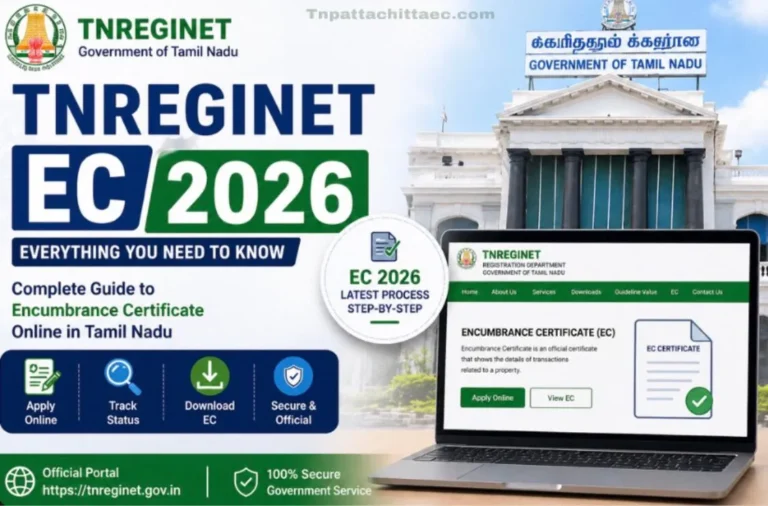
You can get an EC through the tnreginet.gov.in portal by entering your district, zone, village, and survey details. The EC lists all registered deeds — sale deeds, mortgages, gift deeds — for up to the last 30 years.
A clean EC plus your registered sale deed is strong enough for most banks to at least start your file while the Patta records are sorted.
Option 7: File an RTI Application
If the VAO and Taluk office are both unable to trace your record, the Right to Information Act gives you another tool. You can file an RTI application to the Revenue Department of Tamil Nadu asking for a certified copy of your land record.
Address the RTI to the Public Information Officer (PIO) of the concerned District Revenue Office. Mention your survey number, subdivision number, district, taluk, and village name clearly. The department is required to respond within 30 days.
This approach works well for old ancestral land where the original Patta was issued decades ago and physical records exist only at the District Revenue Office on Kamarajar Salai, Chepauk, Chennai — 600005. You can also email the Survey Department at dir-sur@nic.in or call the helpline at 1100.
When You Need Patta Transfer, Not a Record Search
If the land record exists but shows the previous owner’s name, you don’t have a missing record problem. You have a Patta transfer problem. These are two very different situations.
After a sale or inheritance, the Patta must be updated to reflect the new owner’s name. Until that mutation is done, selling the land or obtaining loans can be difficult.
You can apply for Patta transfer online through the TamilNILAM portal by uploading your sale deed, EC, and identity proof. Alternatively, walk into any E-Sevai centre and apply for Rs. 60. Final verification and approval are carried out by VAO/Taluk officials — so some processing time is expected either way.
Summary: What to Do Step by Step
- Check the correct land type. Urban land needs TSLR, not rural Patta Chitta.
- Re-check your survey number. One wrong digit changes everything.
- Look up the A-Register Extract on the same portal.
- Contact your VAO with your sale deed and old documents.
- Visit the Taluk office for certified copies or manual search.
- Go to an E-Sevai centre to submit a formal request.
- Use your EC as interim proof while the Patta is being sorted.
- File an RTI if all else fails, especially for old ancestral land.
The online portal has made land records more accessible than ever. But when it doesn’t work, the offline options work just as well — sometimes better. Keep your documents organized, know your survey number, and don’t hesitate to walk into your local revenue office.
The record exists somewhere. You just need to know where to look.