Are Patta Chitta Records Valid Outside Tamil Nadu in 2026?
You own land in Tamil Nadu. Maybe it’s near the East Coast Road in Kanchipuram or a plot off the Salem bypass near Omalur. Patta Chitta Records. Now you’ve moved to Bengaluru or Hyderabad. A bank asks for land documents. You hand them your Patta Chitta.
They stare at it. They ask for something else.
This happens more often than people think. And the confusion is real. Let’s clear it up once and for all.
What Is Patta Chitta, Exactly?
Before we talk about validity, you need to understand what this document actually is.
A Patta is the official ownership record of a property issued by the Revenue Department. It legally establishes the owner’s claim to the property. Patta Chitta Records Think of it as the government’s way of saying, “Yes, this land belongs to this person.”
Chitta is the land revenue record. It shows the classification of land and confirms whether it is agricultural or non-agricultural.
In 2015, Tamil Nadu combined Patta and Chitta into a single digital record, merging ownership and land classification into one document. So when someone says “Patta Chitta” today, they mean this merged digital record.
It is issued by the Tamil Nadu Revenue Department. It covers land across Tamil Nadu districts, from the rice fields of Thanjavur near the Cauvery delta to the hill towns near Palani and Kodaikanal. It is the backbone of every property transaction in the state.
The Simple Answer: Is It Valid Outside Tamil Nadu?
Patta Chitta records are valid and important land documents, but only within Tamil Nadu. They have no legal authority for land located in other states because land records in India are maintained state-wise, not centrally.
That’s the direct answer. No beating around the bush. Patta Chitta Records
India does not have a single national land record system. Each state runs its own. Tamil Nadu uses Patta Chitta. Karnataka uses the Record of Rights, Tenancy and Crops (RTC), also called a Pahani or 7/12 extract. Andhra Pradesh and Telangana use their own Pahani records. Maharashtra uses the 7/12 Utara. These are all different documents for the same purpose, and none of them are interchangeable across state lines.
Why Can’t Patta Chitta Work in Another State?
The reason is simple: even if the owner is the same, the location of the land decides which document is valid for Patta Chitta Records.
Land records prove ownership of a specific piece of land at a specific location. A Patta Chitta issued by the Tamil Nadu Revenue Department covers land surveyed and registered in Tamil Nadu. If your land is in Krishnagiri near the Karnataka border, Patta Chitta is valid there because it is still Tamil Nadu soil. But the moment that land crosses into Hosur’s industrial estates on the Karnataka side, a different set of documents applies.
The state government that issued the document has jurisdiction only within its own state. No authority outside Tamil Nadu is legally bound to accept a document issued by the Tamil Nadu Revenue Department for land within their borders.
What Documents Replace Patta Chitta in Other States?
If your land is located outside Tamil Nadu, you must use the local land record document of that state.
Here is what applies in the major neighboring states:
Karnataka: RTC (Record of Rights, Tenancy and Crops), also called a Pahani. You get it from the Bhoomi portal at bhoomi.karnataka.gov.in.
Andhra Pradesh and Telangana: Pahani or Adangal. Available through the Meebhoomi portal.
Kerala: Thandaper register extract and possession certificate. The land records are managed by the Survey and Land Records department.
Maharashtra: 7/12 Utara and 8A extract. Available through the Mahabhulekh portal.
Uttar Pradesh: Khatoni and Khasra records. Available through the UP Bhulekh portal.
Each of these is the official land record for their respective state. They serve the same purpose as Patta Chitta but are legally valid only within their own jurisdiction.
Can Patta Chitta Be Used as Supporting Proof Outside Tamil Nadu?
This is where things get slightly nuanced.
In most cases, no. However, Patta Chitta may sometimes be used as supporting identity or address proof. But it cannot replace the official land record of another state. Patta Chitta Records. Final authority always lies with the local state document.
Here is a practical scenario. Say a Tamil Nadu resident owns land in Madurai near the Meenakshi Amman temple area and also owns a flat in Pune. If they apply for a home loan on the Pune flat, the bank will ask for Maharashtra land records for that property. Their Madurai Patta Chitta is irrelevant for the Pune transaction.
However, if the same person needs to prove their identity or show they are a property owner in general, they might attach the Patta Chitta as one of several supporting documents. But it cannot stand alone as the primary land title in another state.
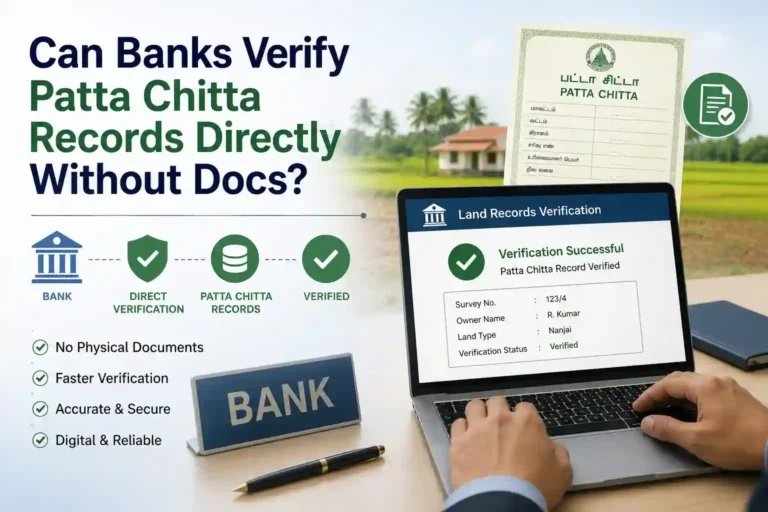
What About Bank Loans? Will Banks Accept Patta Chitta Outside Tamil Nadu?
Banks require the local state’s land record, not Patta Chitta, for property located outside Tamil Nadu.
Banks follow the law of the land where the property is located. If you want a loan against land in Coimbatore, the bank branch in Mumbai will still ask for the Patta Chitta from Tamil Nadu, because that is where the property is. The bank’s location does not change the required document. The property’s location does.
Banks and financial institutions require a valid Patta Chitta or Encumbrance Certificate to ensure clear title before approving loans. For Tamil Nadu properties, this remains fully valid and non-negotiable in 2026.
For farmland specifically, banks require a valid Patta Chitta in the farmer’s name before sanctioning any agricultural loan. The land classification, whether Nanjai or Punjai, determines the loan amount and interest rate.
So the rule is: the document must match the state where the land sits.
Courts and Legal Disputes: What Happens in Inter-State Cases?
Courts rely on the land records of the state where the land is located. Generally, Patta Chitta will not be accepted in courts for land outside Tamil Nadu.
But here is what often confuses people. If you are a Tamil Nadu resident involved in a property dispute in another state, you might need to produce Patta Chitta to prove your identity, your financial standing, or your ownership of other assets. Patta Chitta Records In this limited context, courts may review it. But for the actual disputed property outside Tamil Nadu, only that state’s land records carry legal weight.
Courts consider Patta Chitta as a strong supporting document, though not absolute title proof, even within Tamil Nadu. This matters. Even inside the state, Patta Chitta is powerful evidence but not the final word. Outside the state, its weight drops further.
NRIs With Tamil Nadu Land: Special Situations in 2026
Many NRIs living in cities like Dubai, Singapore, London, or Toronto own ancestral land back home. Some hold plots near popular NRI investment corridors like the East Coast Road (ECR) between Chennai and Mahabalipuram, or in emerging townships around Oragadam off the Chennai-Bengaluru highway.
For these individuals, Patta Chitta remains completely valid for their Tamil Nadu land no matter where they live.
NRIs who own ancestral or purchased land in Tamil Nadu can access the eservices.tn.gov.in portal from anywhere in the world. The portal is fully accessible internationally with no VPN or special configuration required.
The validation of Patta Chitta is about the land’s location, not the owner’s location. An NRI in Toronto checking their Patta Chitta for a plot in Tirunelveli is using a fully valid document. That same NRI’s land record has no relevance if someone asks them to prove ownership of Canadian or any other country’s property.
The 2026 Update: New Land Registration Rules in Tamil Nadu
Tamil Nadu tightened its property laws this year.
Under the New Land Registration Rules 2026, the presentation of original title documents is now legally mandatory for all registrations. You cannot register a sale without a valid Patta in the seller’s name.
This makes Patta Chitta even more important inside Tamil Nadu. If you are buying land near the Tambaram-Vandalur stretch or a plot in Villupuram district, your sale deed cannot be registered unless the seller’s Patta is clean and updated.
This rule change underlines one clear point: Tamil Nadu is strengthening the legal weight of Patta Chitta within its borders. Patta Chitta Records. But this also means the document is increasingly specific to Tamil Nadu’s legal framework. It is not designed to function elsewhere.
Equivalents of Patta Chitta Across India: A Quick Reference
| State | Document Name | Portal |
|---|---|---|
| Tamil Nadu | Patta Chitta | eservices.tn.gov.in |
| Karnataka | RTC / Pahani | bhoomi.karnataka.gov.in |
| Andhra Pradesh | Adangal | meebhoomi.ap.gov.in |
| Telangana | Pahani | dharani.telangana.gov.in |
| Maharashtra | 7/12 Utara | mahabhulekh.maharashtra.gov.in |
| Kerala | Thandaper Extract | erekha.kerala.gov.in |
| Uttar Pradesh | Khatoni | upbhulekh.gov.in |
Each of these is the legal equivalent of Patta Chitta for its state. Patta Chitta Records None of them are valid across state lines for the primary property being transacted.
Practical Checklist: Using Land Documents Across States
Before you walk into a bank, court, or registration office outside Tamil Nadu, run through this:
- Is the land in Tamil Nadu? Use Patta Chitta. It is fully valid.
- Is the land in another state? Get that state’s official land record. Do not use Patta Chitta as a substitute.
- Is this a loan application? The bank needs the record of the state where the collateral land sits.
- Is this a legal dispute? The court of jurisdiction follows the law of the state where the property is located.
- Are you an NRI managing Tamil Nadu land? Patta Chitta is valid. Access it through eservices.tn.gov.in.
- Do you need identity or ownership proof as a general document? Patta Chitta can act as supporting proof but never as a standalone land record for property in another state.
Why This Confusion Exists and How to Avoid It
The confusion around Patta Chitta validity often starts with one thing: people assume that because a document is official and government-issued, it carries weight everywhere. This is not how land law works in India.
Tamil Nadu has a well-established and structured land administration system. Every piece of land is categorized, tracked, and taxed by the government. These records are the foundation of legal ownership. Without accurate and up-to-date records, ownership claims may be weakened.
This strength is precisely what makes Patta Chitta valuable. Patta Chitta Records, but it is strength within a defined territory. The Tamil Nadu Revenue Department’s authority ends at the state border.
People who own land in multiple states, or who have moved cities for work like IT professionals who settled in Bengaluru from Chennai neighborhoods like Velachery or Perambur, often fall into this trap. They keep relying on familiar documents for unfamiliar jurisdictions.
The fix is simple: always match the document to the state where the land is located.
Frequently Asked Questions
Can Patta Chitta be used for property transactions in Bengaluru?
No. Patta Chitta is not valid for land in Bengaluru. You need the RTC issued by the Karnataka Revenue Department.
Is there one land document valid across all of India?
No. India does not have a national land records system in 2026. Each state manages its own land registry independently.
Can I use Patta Chitta as address proof in another state?
Sometimes yes, as a supporting document for identity or address verification. But it is not a substitute for that state’s official land records.
What if I have Tamil Nadu land and want to mortgage it from another city?
The Patta Chitta for your Tamil Nadu land remains valid and required. The bank will process the Tamil Nadu property using Tamil Nadu land records regardless of which city you apply from.
Is Patta Chitta valid for apartments in Tamil Nadu?
Patta is generally required for land and independent homes. Apartments are covered under the parent land’s Patta.
The Bottom Line
Patta Chitta is one of the most reliable land records in India. It is backed by the Tamil Nadu Revenue Department, fully digitized through eservices.tn.gov.in, and recognized by banks, courts, and registration offices across the state.
But its authority stops at Tamil Nadu’s border.
For any inter-state property matter, whether it’s selling land, applying for a loan, or legal verification, you must use the local land record document of that state. Patta Chitta Records: Using the correct document avoids delays, rejection, and legal confusion.
If you own land near Chennai’s OMR tech corridor, the fields of Kumbakonam, or the foothills of the Nilgiris, your Patta Chitta is perfectly valid and legally powerful. The moment the conversation shifts to land outside Tamil Nadu, move to the right document for that state.
That one simple rule saves time, money, and a lot of unnecessary trips to government offices.