How to Use Patta Chitta to Apply for Govt Welfare Programs in Tamil Nadu
If you own land in Tamil Nadu and haven’t used your Patta Chitta to access government benefits, you’re leaving real money on the table.
This document is not just a land record. It’s your ticket to housing schemes, farm subsidies, crop insurance, and financial assistance programs run by the state government. Whether you live near the fields of Thanjavur or the narrow lanes of Triplicane in Chennai, your Patta Chitta is the first thing most welfare offices ask for.
This guide walks you through exactly what Patta Chitta is, which government programs need it, how to get it online, and what to do when things go wrong.
This is written for real users. Farmers, land buyers, and families who depend on government support.
What Is Patta Chitta and Why Does It Matter?
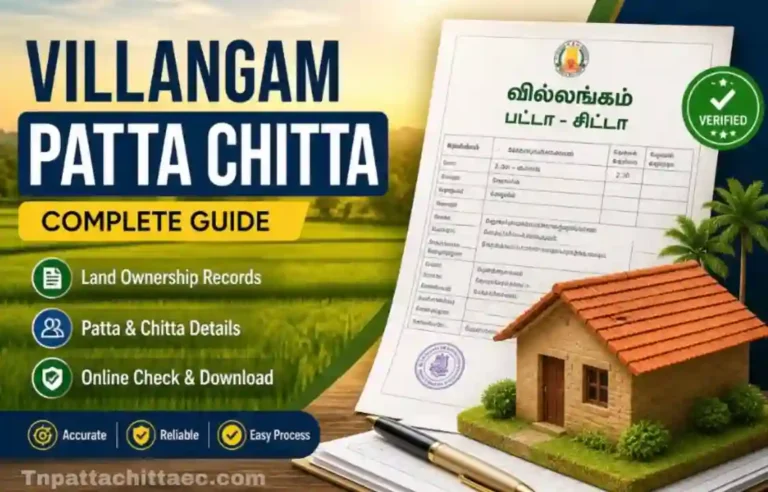
Patta Chitta is a land record issued by the Tamil Nadu government. It confirms ownership and land classification. Patta shows the owner’s name and survey number.
Chitta shows land type such as Nanjai or Punjai.
These records are maintained by the Tamil Nadu Revenue Department.
When you apply for welfare schemes, the government checks land ownership. Patta Chitta acts as proof. Without it, most land-based benefits cannot be processed. Before 2015, Tamil Nadu maintained two separate documents for every land parcel. Patta confirmed who owned the land. Chitta described what kind of land it was — wetland (Nanjai) or dryland (Punjai). The Revenue Department merged both into a single unified record called Patta Chitta.
Today, one document tells the full story. It shows the owner’s name, survey number, land area, district, taluk, village, land classification, and tax details. The Village Administrative Officer (VAO) at your local revenue office maintains this record. The Tahsildar in your area has the authority to issue or transfer it.
For farmers working in Karur or Erode, this document confirms whether your land is wet or dry — a key factor in crop insurance and subsidy eligibility. For families in Madurai’s Tallakulam neighborhood applying for housing assistance, it proves you legally own the plot your home sits on.
No Patta Chitta, no proof. No proof, no benefits.
Why Government Schemes Ask for Patta Chitta
Government programs aim to support genuine landowners. This includes farmers, rural households, and small landholders.
Authorities verify three things:
- Ownership of land
- Type of land
- Extent of land
Patta Chitta provides all this information in one place.
It reduces fraud. It ensures benefits reach the right person. That is why it is mandatory for many schemes.
Welfare Programs That Require Patta Chitta
Many schemes in Tamil Nadu require land proof. Below are common examples.
1. Farmer Subsidy Schemes
Farmers receive subsidies for seeds, fertilizers, and equipment.
Programs like PM-KISAN and state agriculture subsidies need land proof.
Patta Chitta confirms that you are the actual cultivator.
2. Crop Insurance Programs
Crop insurance protects farmers from losses due to floods or drought.
Insurance agencies verify land ownership before approval.
Patta Chitta is used to match the survey number with the crop area.
3. Housing Schemes
Programs like rural housing schemes require proof of land.
If you apply for a house under government schemes, you must show ownership.
Patta Chitta proves you own the land where the house will be built.
4. Loan and Financial Assistance
Banks and cooperative societies require land documents for loans.
Patta Chitta helps verify ownership before loan approval.
It is also used for agricultural loans and subsidies.
Government Welfare Programs That Need Patta Chitta
Dozens of schemes across Tamil Nadu directly require a valid Patta Chitta at the time of application. Here are the key ones.
1. Tamil Nadu Housing Board Schemes (TNHB)
The Tamil Nadu Housing Board runs subsidized housing programs for economically weaker sections and low-income groups. Whether you’re applying for a plot near Avadi or a flat in Tambaram, the application asks for proof of land ownership or existing plot details. Patta Chitta serves that purpose.
For self-construction grants, you must show you already own the land. Your Patta Chitta verifies that you’re the legal holder and that no disputes are attached to the property.
2. PM Awas Yojana – Gramin (PMAY-G)
The central government’s rural housing scheme operates through state revenue records. Village-level workers verify land ownership before approving housing grants. In Tamil Nadu, Patta Chitta is the primary document they check.
Families in Villupuram, Tirunelveli, and Krishnagiri districts have used their Patta Chitta to qualify for home construction assistance under PMAY-G. Without it, the application stalls at the first verification step.
3. Pradhan Mantri Kisan Samman Nidhi (PM-KISAN)
PM-KISAN gives farmers Rs. 6,000 per year in three installments. To claim this, you need to prove you’re a cultivating landowner. Tamil Nadu’s revenue system uses Patta Chitta to verify who owns cultivable land.
Farmers near the delta region around Nagapattinam and Tiruvarur — who grow paddy on Nanjai land — regularly submit their Patta Chitta as part of the PM-KISAN enrollment process. The document’s land classification field is what proves the land is genuinely agricultural.
4. Chief Minister’s Farmer Support Scheme (Uzhavar Pathukappu)
This state scheme offers crop insurance and distress relief to farmers. Enrollment requires your land records to confirm land type and acreage. The Chitta section of your Patta Chitta document shows whether your land is Nanjai (irrigated) or Punjai (rain-fed), which determines your crop insurance category.
Without a clear Patta Chitta, the insurance coverage amount is calculated incorrectly — or denied altogether.
5. Adi Dravidar and Tribal Welfare Land Distribution
The state government regularly assigns land to Adi Dravidar families under welfare and land distribution schemes. Once land is allotted, a special “AD Condition Patta” is issued. This patta carries specific conditions on usage and resale.
Families in rural parts of Dharmapuri and Salem who received government-assigned land must maintain this document carefully. It proves ownership and enables access to further welfare benefits tied to that land.
6. Agricultural Loans from Cooperative Banks
The Tamil Nadu Cooperative Bank network provides Kisan Credit Cards and crop loans to farmers. To get these loans, your land must be verified as agricultural and legally registered in your name.
Loan officers at branches near Coimbatore’s SIDCO area or Tiruppur’s cooperative centers ask for Patta Chitta before processing any farm credit application. The document serves as collateral proof and ownership verification in one step.
7. Integrated Rural Development and MGNREGS Benefits
Land improvement works under the Mahatma Gandhi National Rural Employment Guarantee Scheme sometimes require land ownership verification. If your land is selected for farm pond construction, soil conservation, or irrigation improvements, officials cross-check ownership through Patta Chitta.
In dry-belt districts like Ramanathapuram and Pudukkottai, this process is common before any government investment on private agricultural land.
How to Get Your Patta Chitta Online
The Tamil Nadu government made this easy through the e-Services portal. You don’t need to visit any office to view or download your Patta Chitta.
Step 1: Go to the official portal: eservices.tn.gov.in
Step 2: Click on “View Patta & FMB/Chitta/TSLR Extract” on the homepage.
Step 3: Choose your district from the dropdown. For example, if you’re in Chennai, select Chennai. For rural lands in Tiruchy, select Tiruchirappalli.
Step 4: Select your Taluk and Village. In cities, you’ll select a Town and Ward instead of a village.
Step 5: Enter your survey number and subdivision number. You’ll find these on any old land document, tax receipt, or from your VAO’s office.
Step 6: Submit the details. The system shows your Patta Chitta on screen.
Step 7: Download and print the document. It includes a QR code for instant verification.
The download is free of charge. For a Patta transfer application, there’s a nominal fee of around Rs. 100.
Patta Chitta for Urban Properties
If your land is within a municipal corporation area — like inside Chennai, Coimbatore, or Madurai city limits — you won’t find a standard rural Patta. Instead, you’ll access a TSLR (Town Survey Land Register) extract.
The TSLR extract works the same way. It confirms ownership and land classification for properties within city boundaries. When welfare offices in Chennai ask for land records, the TSLR extract is the correct document to produce.
Properties on roads like Anna Salai, Poonamallee High Road, or within ward boundaries of the Greater Chennai Corporation can be verified through the TSLR section on the same eservices.tn.gov.in portal.
Applying for Patta Transfer
If you recently bought land, inherited property, or received land through a court settlement, the Patta still shows the previous owner’s name. You must get it transferred to your name before applying for any welfare scheme.
Here’s the transfer process:
Go to your local Taluk office. Ask for the Patta Transfer application form. Fill in your details and attach these documents: signed sale deed or gift deed, encumbrance certificate from the Sub-Registrar’s office, Aadhaar or voter ID, any tax payment receipt for the property, and a legal heir certificate if the land came through inheritance.
Submit everything with the fee and collect your acknowledgment slip. The VAO and Revenue Inspector will inspect the site. The Tahsildar will then issue the updated Patta in your name.
The process takes 15 to 30 working days under normal conditions. If there’s a pending dispute or boundary issue, it may take longer.
Documents You Need When Applying for Welfare Programs
Welfare offices across Tamil Nadu usually ask for the same core set of documents. Keep these ready before visiting:
Your downloaded Patta Chitta printout (with QR code). A government-issued photo ID like Aadhaar card or voter ID. Proof of residence — electricity bill, ration card, or water tax receipt. Income certificate if the scheme is income-based. Encumbrance Certificate (EC) for programs that involve property loans. Caste certificate where required by the specific scheme.
Make multiple self-attested photocopies. Offices at the District Collectorate level or Taluk offices often need three sets.
What to Do If Your Patta Has Errors
Records with wrong names, incorrect survey numbers, or outdated ownership details are common in older land. These errors block welfare applications fast.
If your name is misspelled or your survey number doesn’t match the sale deed, you need to file a correction application at the Tahsildar’s office. Bring the original sale deed, your current ID proof, and the old Patta document. The VAO will verify, and corrections are usually processed within 30 days.
For boundary disputes or land area mismatches, you may need an FMB (Field Measurement Book) sketch verification. The survey department at your district headquarters handles this. In Chennai, the office sits on Old Washermenpet Road near the Revenue Divisional Office.
Checking Your Application Status Online
After submitting a Patta transfer application, you can track the status online.
Go to edistrict.tn.gov.in. Enter your application ID and the captcha. The status shows whether your file is at the VAO, Revenue Inspector, or Tahsildar level.
If the status hasn’t moved in over 30 days, you can file an RTI request or raise a grievance through the Tamil Nadu CM’s cell at the district level.
Why Keeping Patta Chitta Updated Matters
Some families in Tamil Nadu haven’t updated their land records in years. The Patta still carries a grandfather’s name from three decades ago. This creates serious problems.
Welfare applications get rejected. Loan applications from cooperative banks stall. Insurance claims after floods or droughts are denied because the ownership can’t be verified in current records.
The November 2025 update to the Patta Chitta verification system now uses DGPS-based surveying for higher boundary accuracy. New registrations and transfers reflect faster in the digital database. This means the system is more reliable today than it was five years ago — but only if your records are current.
Key Government Offices You May Need to Visit
Some processes still require in-person visits. Here’s what to know:
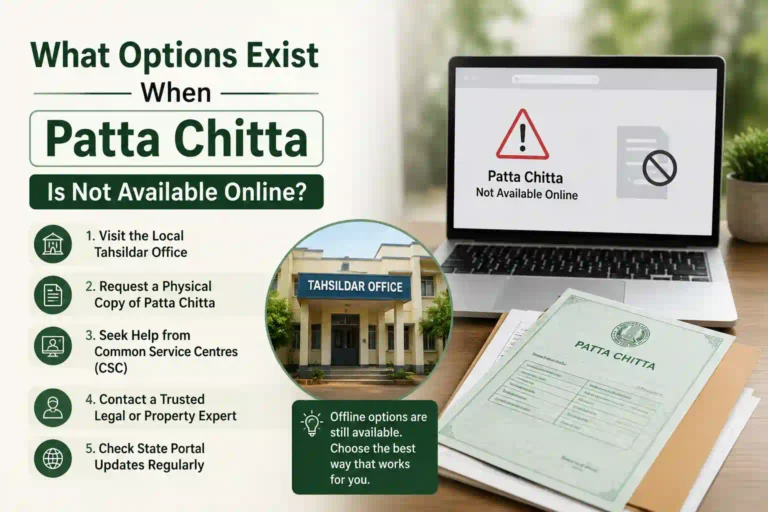
Your Tahsildar’s office handles Patta transfers, corrections, and initial welfare verifications. This is your first stop for most issues.
The Village Administrative Officer (VAO) is your ground-level contact. They conduct site inspections and maintain the Chitta records at village level.
The District Collectorate handles escalated complaints and larger welfare scheme enrollments. In Chennai, this is on Rajaji Salai near Fort St. George.
The Sub-Registrar’s office provides the Encumbrance Certificate when you need to attach it to loan or scheme applications.
The Tamil Nadu e-Governance Agency supports the online portal. If you face technical issues with eservices.tn.gov.in, contact them through the portal’s helpdesk section.
Final Word
Patta Chitta is not complicated once you understand what it’s for. The Tamil Nadu government designed it to make land records simple, transparent, and accessible. The digital portal works well. The information is real-time.
The real problem is that many landowners — especially in rural pockets of Virudhunagar, Tirupattur, and Sivaganga — don’t know they can download it for free, update it online, and use it to unlock government benefits they already qualify for.
Update your records. Download your Patta Chitta today. Then walk into your nearest welfare office or cooperative bank with the right documents in hand. You own the land. Make sure the records prove it.
Frequently Asked Questions (FAQs)
1. What is Patta Chitta and why is it required for government schemes?
Patta Chitta is an official land record in Tamil Nadu. It confirms ownership and land type. Government schemes require it to verify that the applicant owns the land and qualifies for benefits.
2. Can I apply for welfare schemes without Patta Chitta?
In most cases, no. Land-based schemes need proof of ownership. Without Patta Chitta, your application may be rejected or delayed.
3. How can I download Patta Chitta online?
You can download it from the official Tamil Nadu e-services portal. Enter district, taluk, village, and survey number. Then generate and download your record.
4. What details are checked in Patta Chitta during scheme approval?
Authorities check the owner’s name, survey number, land classification, and land area. These details must match your application documents.
5. Can joint landowners apply for government schemes?
Yes, joint owners can apply. But all names must be correctly listed in the Patta. Some schemes may require consent from all owners.
6. What should I do if my name is not in the Patta Chitta?
You need to apply for Patta transfer. Visit your Taluk office with your sale deed and ID proof. Update your record before applying for schemes.
7. How long does it take to update Patta Chitta?
It usually takes a few weeks. The time depends on verification by local officials like the VAO and Taluk office.
8. Is Patta Chitta required for crop insurance schemes?
Yes. Crop insurance programs use Patta Chitta to verify land ownership and match it with the insured crop area.
9. Can I use an old Patta Chitta copy for applications?
It is not recommended. Always use the latest copy. Outdated records may lead to rejection.
10. What is the difference between Nanjai and Punjai in Patta Chitta?
Nanjai refers to wet land used for crops like paddy. Punjai refers to dry land used for crops like millets or pulses. Some schemes depend on this classification.
11. Do banks require Patta Chitta for loans?
Yes. Banks use Patta Chitta to verify ownership before approving agricultural or land-based loans.
12. Where can I correct errors in Patta Chitta?
You can correct errors at your local Taluk office. Submit supporting documents like sale deed and identity proof.
13. Is Aadhaar required along with Patta Chitta for schemes?
Yes. Aadhaar is usually required for identity verification along with land records.
14. Can I apply for welfare schemes online using Patta Chitta?
Yes. Many schemes allow online applications. You can upload your Patta Chitta as a supporting document.
15. Who verifies Patta Chitta details during application?
Local officials such as the Village Administrative Officer and Taluk office staff verify the details before approval.